Tag Archives: Writing

Kicking it off the cliff

the-endOne of the most depressing days in a writer’s life is when they finish their work-in-progress. You’d think it’d be a James Caan break-out-the-bubbly moment like in Stephen King’s Misery, but truly, it’s more like Kathleen Turner in Romancing the Stone, crying like a baby as she types The End. The latter’s an apt analogy, because there ‘s definitely some postpartum issues going on, and although you feel a sense of release, it’s also pretty scary. Mainly because although the creative part is finished the business end kicks in, and suddenly the kind of terror you’re facing makes that Scary First Page look like all kitty and bunny cuteness. You start going all agoraphobia, freaked at the idea of sending Baby out into the cruel, cruel world, completely certain everyone  will discover you for the hack — or even worse — the fraud, the imposter you are. “Take THAT bitch!” you imagine as another rejection skids into your inbox, “who ever told you you can write?” (actually, a “mentor” once did say that to me, an Iowa Workshop graduate who I now can only remember as Dick.) You start doubting yourself, convinced everything you ever wrote is shit and trash-worthy, and you end up with your ass still in pajamas at 4:00 PM eating Tater Tots and binge-watching old episodes of Family Ties. Pathetic.

Of course, this is the most extreme scenario, and not completely reflective of my reality. I’m fortunate enough to have an agent who believes in my work, and a couple good leads on this new thing. But that doesn’t mean everything I described above hasn’t gone through my head, and it’s certainly nothing I haven’t faced before. (Okay, no Family Ties, but I did recently binge five episodes of Outlander and nearly the whole season of Girls.) The thing is no matter what stage you are in your writing career, you’re not immune to self-doubt and imposter syndrome and the fact that you’re only as good as your latest success. But that doesn’t mean you shouldn’t let go. I did, and as proof–oh what the hell, here’s the first chapter of my latest book to prove it. Go ahead and read it and let me know what you think. Just don’t make me call you Dick.

All systems stop

Brick wallRight now I’m in the process of editing my latest book, and for the most part, it’s rolling along superbly. I have a terrific premise, stellar characters, lots of quirkiness and some great dialogue. I always keep in mind the big picture–the one thing I want to accomplish and how it all will eventually end up. For one reason or the other I can always visualize the last scene, where the characters will be and the affecting bon mots that’ll roll off their tongue which will hopefully, linger in my readers’ minds. And then three-quarters of the way in, I turned around and just like that! I ran face-first into a brick wall.

Stopped. Not stalled–I’m talking dead motor. I couldn’t move an inch and worse than that, I didn’t know why. I thought at first I was stymied by the research, as there’s some technical devices I’m using that needed to be clarified. But that wasn’t it either, and it wasn’t the pacing, because it was going along at such a rapid clip I made a conscious effort to slow it down. Then it hit me (metaphorically): I couldn’t go on because I didn’t know one of  my characters well enough. And when you don’t, how could you possibly know what they’ll do next?

According to Nancy Lamb in The Art and Craft of Storytelling, “how your characters act and react–how they think and feel; how they handle obstacles and respond to people, places and things is story.” Agreed. I have some great characters. They’re colorful and full of nuance, they have interesting backstories and deliver some killers lines. Yet…and this took me a bit of thinking to figure out–they’re still one-dimensional. I’m working with them, but I don’t really know them. I’m hitting that wall of what-to-do-next because this far into the book I can no longer write them observationally, or how the opposing characters see them. I have to write them motivationally or how their unique combination of nurture, nature, inclination and quirkiness force them to do the things they do.  So I stopped and thought about the plot situation my character was in, and that’s where I found my moment of clarity. I couldn’t predict what he’d do next because I’d yet to give him justification. Oh sure, I knew his present because I had observed it through the eyes of the other characters. But I wasn’t well-enough acquainted with his personal history to give him a motivation to react the way that would advance the story. So to help that along, I devised a little checklist to run him through.

Personality  – Is he aggressive or passive? Confident or shy? Is he willing to take chances, or does he like to play it safe? Cheerful or moody?

Defining Traits – Is he a geek or a loner? A leader or a follower? Fun or a bit of a wet blanket? Is he cold? Is he liked or feared, and how much does that matter to him?

Family – Is he close to them or estranged? Married or does he want to be? Any children? Youngest, middle or oldest? Pets?

Interests – What is he passionate about? Any hobbies? Political? A patron of the arts? What does he really dislike? And how does this conflict with the other main character?

Clothes – Does he dress nattily? Or like a slob? And what does he observe in others?

Body Language – How is his handshake? Does he always make eye contact? Does he walk confidently or does he cower?  Does he listen?

This is just a short list as you can go on and on, but by the end you will end up knowing your character a bit better. And when you do you can finally sit back and relax. They’ll take it from there.


What I did last Saturday

Gretchen Gwen Chris Clemetson LSFW
Geniuses, all: Gretchen Weerheim, moi, Chris Clemetson.

Just because I have a few books out there with a Big Five publisher that doesn’t make me a somebody. (Okay, maybe it at least qualifies me for Amateur Plus status.) But once in a while I do get out in the World for a chance to mingle with the famous and near-famous, and that can only up my cred. Last weekend I was at the seventh annual Liberty States Fiction Writers Conference in Iselin, here in my home state of New Jersey. It’s a fun event,  with workshops and panels and editor/agent appointments, speakers like Hank Phillippi Ryan.  I even got to attend a wicked Mad Libs session given by Kate McMurray,  Tere Michaels  and Damon Suede. And who knows, maybe I even learned something.

Gretchen, Hank Phillippi Ryan, Yours Truly
Kate McMurray, Tere Michaels, Damon Suede at Mad Libs LSFW

Writers Anonymous

hand blocking cameraAre you ever ashamed to call yourself a writer? I don’t mean consciously, but when someone asks you what you do, and I’m not referring to your nine-to-five job, do you shy away from mentioning your “shadow” career, only “admitting” it to your closest friends? Or when someone asks you “what’s new?” do you tell them you’ve just finished your latest chapter, or do you toss them non sequiturs? Do you answer your partner’s “What are you doing?” with “Oh, nothing,” even if you’re neck-deep into plotting? Do you consider your writing a guilty pleasure rather than a necessary part of your overall mental health? And most of all, do you write only when you can steal some time away from the “more important” things you have to do? Does any of this sound familiar? If it does then I have news for you: you’re seriously disrespecting The Work.

Easy for you to say, you may be saying. I have a home. A family. Kids. A job.  A cranky spouse. Responsibility! Bills to pay! <Fill in this blank with your bitch.> I get it. I GET IT.  I’m not saying you don’t have any of that. And I’m not denigrating it. You are. And why’s that? Because what you’re telling me is this “secret passion” you have is not important enough for the public. That it’s just some silly little thing you do now and then. And it deserves significantly less attention than your more respectable pastimes, such as checking Instagram on your phone, watching “The Walking Dead,” or hoisting a few on the deck (I may be persuaded to reconsider the last one). And that’s fine–as long as that’s how you really feel. Do you?

Truth be told, I used to. I hid my more creative bent from my friends and family, only indulging in it during what is known as “free time,” which could be exclusive of anything in the world from chopping wood to piloting the International Space Station, as long as it didn’t involve writing. But the thing was, I didn’t write any more or less. I still devoted an inordinate amount of time to my fiction; I just accomplished it after everything else “more important” was finished, even if I had to work late into the night. Then came the ultimate paradigm shift–I began to make money. Overnight my little hobby gained immediate legitimacy. Which forced me to ask myself, Does it take making money before anyone will take me seriously? A big resounding NO, and you know why? Because if I weren’t already taking myself seriously, I would’ve never been able to write well enough so someone else–someone like an editor–would consider my writing worth the risk.

You see, good writing doesn’t spring from your laptop by chance; it’s cultivated. It’s not enough to plant the casual seed and see if something will eventually come up, like so many random chimpanzees at countless random typewriters. It’s work. And if you are, indeed, a writer, my goodness! It’s nothing to be ashamed of!


Master of One

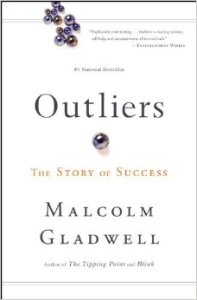
Outliers by Malcolm GladwellMalcolm Gladwell’s Outliers (Little, Brown & Co. ) is not a new book. In fact it’s over eight years old, but it is one that I’ve read lately. As in the other Gladwell books (The Tipping Point, Blink), the author picks a subject and expands on it, or as he explains in his website, I write books when I find myself returning again and again, in my mind, to the same themes. Said theme for Outliers was, and I liberally interpret: Why do some people become successful and others, who are just as educated and innately intelligent, don’t? This is a question I have posited myself, as I have seen some people rocket to the top of their chosen profession while many of their peers struggle and remain perennially in the backfield. So I picked up Gladwell’s book hoping to find not so much answers as explanations, and I certainly received what I was searching for. Not that it made me feel any better. In fact, there’s a simple word to explain exactly how I felt.

Screwed.

As Gladwell theorizes, it’s not how hard you work, but how advantageous you were in where and when you were born, and how the culture in which you developed shaped you. In essence, as hard as some people work to succeed, the vast majority of those who do find success do so aided by circumstances beyond their efforts. Or as the author puts it: …we vastly underestimate the extent to which success happens because of things the individual has nothing to do with. Now, who hasn’t heard the stories? The accountant who just happens to send his resumé in on the day another accountant gets fired, and gets hired, purely out of necessity. The actor who gets to star in a blockbuster film after the first pick for the role turns it down. Or as in Bill Gate’s case, growing up in Seattle the son of a wealthy lawyer whose private middle school, in 1968, was able to afford a unique computer for him, and a few other select geeks, to use on their own. A computer, tied to a main-frame up town, which Bill and his cohorts got to use day and night and weekends and all summer until all they did was program and program and program, until this coding-jones replicated exponentially into Microsoft. My God, how could you compete with those innate set of circumstances? Because part of what Gladwell expounds on, what ultimately leads to Bill’s success, lay not so much in the advantages, as the time he spent perfecting his craft. His 10,000 hours.

Gladwell postulates that in order to be considered a Master in any given field, one must spend a minimum of ten years, or ten thousand hours,  grinding away at it. Bill started out by obsessively programming for almost 1,600 hours in one seven month period. Likewise, the Beatles launched their career by performing in Hamburg, Germany, for 270 nights in a little over eighteen months, for almost 1200 hours. Reading that, I began to feel a little better about myself, as I’ve had my own set slave-driving circumstance. To wit:

You may as well know, I’m an academic.  I have a Master of Fine Arts degree in Writing and  at the time my thesis, a novel, was in progress, I was working on a three-book contact. So, in one ten-month period, I wrote one 80,000 and three 50,000 word novels, as well as several papers, four grant proposals (I minored in grant writing), and two short stories. This is addition to all the ancillary writing that goes along with the business of submission and course requirements, so I spent many a weekend from sun-up to -set still in my dressing gown, gaining my sustenance by anything I could eat with one hand. At times, it wasn’t a pretty sight, but it was always exhilarating and ultimately very rewarding.

The end result is I can drop prose like others drop trou, and now I get to teach people how to do it. I’m not perfect, I’m still a work-in-progress, but I can honestly say I love what I do. And if you can say that, well then, your working days are done.

Liberty States Fiction Writers Annual Conference is coming! March 19-20, 2016

banner300x300Hey writers! Looking for something to do on these cold winter days? How about looking into the 7th Annual Create Something Magical Conference Saturday, March 19 thru Sunday, March 20, 2016 at the Renaissance Woodbridge Hotel in Iselin, NJ.

  • Two days of workshop offerings for both Writers and Readers
  • Editor/Agent Appointments
  • An open to the public book signing
  • Dessert and dancing at our Saturday night party
  • Tons of opportunities to meet and connect with readers and authors
                                                    Keynote Speakers
New York Times &
USA Today Bestselling Author

Catherine Bybee
AND Mary Higgins Clark
Award Winning Author

Hank Phillippi Ryan
Catherine Bybee

For more info follow this link to LSFW!

hank-2013-bio


Boo Effing Hoo – get your ass in the chair

vintage-writer-at-old-typewriterOne New Year’s resolution I’m sure plenty of writers made was finally attempting that full-length novel. For some, NaNoWriMo in November gave them their first taste of what long form writing’s like, as a national novel-writing month forces derriere-in-chair and excuses out the window. But what if no amount of incentive will work? What if you just can’t get in the mood to write?

If you consider yourself a writer, then no one has to tell you about black moods. To a writer, they’re as welcoming as a rejection and as familiar as the backspace. Our black moods spawn as much from those brick walls we face as from the months we spend waiting for an answer, and when we do it’s often nothing we want to hear. Our dismal days are frequently filled with endless rewrites, verbal vomit and dead ends, and the inevitable recalcitrant character who insists on upending the plot. Sometimes when it gets really bad we end the day dispirited and frustrated, cursing our near obsession as we cry into our goblets of pinot noir, gorging on double-chocolate brownies and tater tots.  ANYWAY, this writing life can sure enough get you down now and then, no fooling. So what’s a sullen scribe to do?

Milk it, I say. Milk it for all it’s worth, right down to the quick until it’s pink and screaming. Believe it or not, your darkest days can bring out some of your most illuminated writing, as you dig into the depths of your rawest emotions. You need to write a scene where your protagonist loses the love of his life? His job? His home? His space in line for the newest iPhone? Drag yourself to your keyboard and lose your troubles in his, as pouring all that angst into your prose will make it so much richer and realistic, not to mention the cathartic bonus you’ll get out of unloading it all into some unwitting character. The same thing can work in reverse, too. Write your heroine falling in love on the day you finally nail that job, fit into those skinny jeans, eat a perfect peach. Works really well when you’re angry, too, letting that poor, downtrodden patsy finally give the bully his due as he lands a left dead-on his fictional jaw. Hey, it’s better than shoving your own fist into the sheet rock. It’ll save you a ton of dough in repairs, leaving more money to spend on pinot noir, tater tots and–oh, we’ll just leave that up to our very fertile imaginations, now won’t we?


My Post-Holiday Sugar Crash

BirdfeederIt’s a sunny morning in my neck of New Jersey, and unlike the photo to the left, snow-free. The wind is relatively calm, and from my window I can see all kinds of birds pecking at the feeder and except for the barren vegetation, it could almost be anytime of the year. But it isn’t, and I don’t need to step outside into the mid-twenties chill to feel the hollowness of the season in my bones, especially when the Weather Bleaters are predicting a Snowmageddon for the weekend.  Sorry if I’m being a bit of a Debbie Downer, but seriously, after the choreographed optimism of the New Year fades back into the mundane, what are we actually left with? Only the anti-climatic yawn of the Dead of Winter and the mind-numbing ennui that follows.

Maybe it’s just a sugar crash after all those Christmas cookies, but last fall’s good intentions and best laid plans now seem as sensible as earmuffs in August. What happened to that get-up-and-go, those ideas that seemed so workable, those plans set to be implemented as soon as the everything got back to normal, post-holiday? Instead, you’re quickly finding out that things don’t really change, that everything goes comfortably back to the way it was, or more often than not, gets just a little bit worse. (Like waiting for that first paycheck of 2016? Times like these make you wish you’d majored in creative accounting and not creative writing.) You’re finding yourself just a little more broke, a touch fatter, a tad less cheerful and a whole lot lazier. A stretch on the sofa feels more natural that an extended stretch at laptop, and when you do find yourself in front of a screen, it’s more likely for Netflix than for fixing that severely flawed manuscript.

Not that you haven’t tried. To fix that manuscript, I mean. But everything you seem to write is crap. As it was the last time you looked at it just before Christmas. When you told yourself you’d make it better next month. When you had more time. When everything calmed down.  After the New Year. When all that holiday hoo-hah is behind you and you can finally think again. In January. Because in January the Universe presses the big RESET button and all wrongs get righted, everything gone down goes up, all promises are kept. When the Muse of Inspiration suddenly infuses us with glorious plot threads, miraculous turns-of-phrase and endings so sock-blowing that ever-elusive editor you queried back in the fall suddenly jumps from your proposal and screeches “MY GOD! THIS IS GONNA MAKE US MILLIONS!”

As if. So what to do?

Beats me. I’m depressed, remember? Deads of Winter tend to breed brain-deadness. Or at least that’s how it feels from here. All I can offer is this isn’t my first Dead of Winter, that I’ve made it through several, and there’s just something about January that breeds contempt. And invariably, things do pick up by February. Maybe it is all that holiday crap we ingested and like a six-year-old on Halloween night, we just need to sleep it off.

Okay, whine over. Back to work.


Writers’ little helpers when the caffeine ain’t enuf

drugs-blogBy Grant Snider via GalleyCat and James Boog. This speaks to me, especially left-center, though I’m sure you writers out there can draw from it what you need. The New Yorker cuts worse of all. But still, I’m addicted. Heaven help me!


Rejection, you old bastard

Writers Write!The other day I received in my inbox one of the most eagerly unanticipated of emails – the dreaded rejection. It wasn’t my first, and it most certainly will not be my last. In fact, it was another in a long, and happily broken line of such letters, which at this point in my career, totals well over one hundred. Through the years I’ve received all kinds, reaching back to the pre-electronic era: my own typed query with a rubber-stamped REJECTED across it, thrifty pre-printed postcards tucked into my SASE, crookedly off-centered-Xeroxed form letters, flyers inviting me to partake in the purchase of 1) editorial services, 2) how-to books, 3) seminars, even one with a large NO scribbled across the body of the letter. Of the electronic variety, I’ve received mainly cut-and-paste form emails, some three months after I submitted, to one within the hour. Several of these, especially of late, have been what is popularly known as good rejections, dismissals of a more personal nature, where the sender comments on what they liked and disliked about the work, more often than not praising the writing, but not “falling in love” with the story. Often the sender will point out the subjective nature intrinsic to all rejections, and wish you “the best of luck in finding a home/editor/agent for your novel/project/work.” Although rejections of this ilk are often sent with the kindest of cuts, because of the higher level of expertise the writer has demonstrated by the point, they’re usually the toughest rejections of all to take.

I’ve seen many a writer crumple in despair over such rejections, burn their manuscripts, erase their hard drives, lose themselves in a blurry of cheap liquor and even cheaper chocolate (yours truly suggests burrowing into a Himalaya-size pile of Tater Tots). Many vow to give up writing for good, and sometimes many do, at least temporarily, and often that’s a good thing. Because once the hurt and the anger and the self-deprecation subside, the writer can take a step back and look at the work objectively. Subjectivity aside, editors and agents, more than anything else, are professional readers, and if the work comes back over and over with similar commentary, maybe it’s time to take a look at that particular aspect of the story. In the same vein, the writer also has to consider where the work was sent and the editors’/agents’ preferred genres. Are you submitting mystery when the agent’s preference is sci-fi? Have you sent a novel query to an editor who usually publishes self-help? Have you taken a look at the agent’s clients? The editor’s list? Have you read the acknowledgement pages of works similar to yours to see who the author is thanking? You have? Then good, but let me ask you this: do you have multiple queries out there, or are you placing all of your literary eggs into the basket of one editor/agent?

If you are, you are most certainly setting yourself up for disappointment. Submission should be a very fluid process, and sending to one editor/agent at a time is akin to hitting a stop sign on every corner, causing your writing to lose momentum. For the most part, your writing life should have two very distinct entities – the creative and the practical, and as hard as it is to separate one from the other, the two should never align. Plus if you have multiple queries out there at once, the random rejection tends to lose its sting, and the dismissing editor/agent diminishes in importance. But most of all, you should never, ever let a rejection sink you so low that you lose faith in your abilities, a point where I’ll admit I have found myself. Instead of wallowing in dejection, ask yourself this: Who are these people who wield such power that I allow their judgment to supercede mine? Confidence in your talent will show through in your work, and you should always be exercising your writing muscle. As I tell my students, writers write, and no one was more surprised than me by my reaction to that latest rejection. Sure, it rattled me, but all I could think about was finishing the chapter I had been working on, which I did before I went to bed that night. To me, that meant I had lived through one more rejection, and had come out the other end, still a writer.

A while ago, when I was less confident, I had poured my heart out to my sister over one particularly brutal rejection. She told me of an article she had read in the New York Times about author James Lee Burke, and his fourth novel, The Lost Get-Back Boogie. By his own accounting, the manuscript was rejected by 111 editors over a nine-year period. When it was finally accepted and published, it went on to be nominated for the Pulitzer Prize. It’s now translated all over the world, and has gone into numerous printings. I never forgot that story, and many times it has kept me going. It made me think that one day, if I’m lucky enough, my own tales of desperation and abject failure will rally someone on to success. Only if!