Category Archives: Unsolicited Writing Advice!

How did you get along without it?

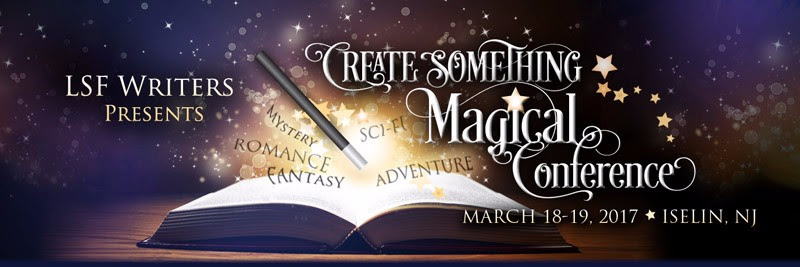
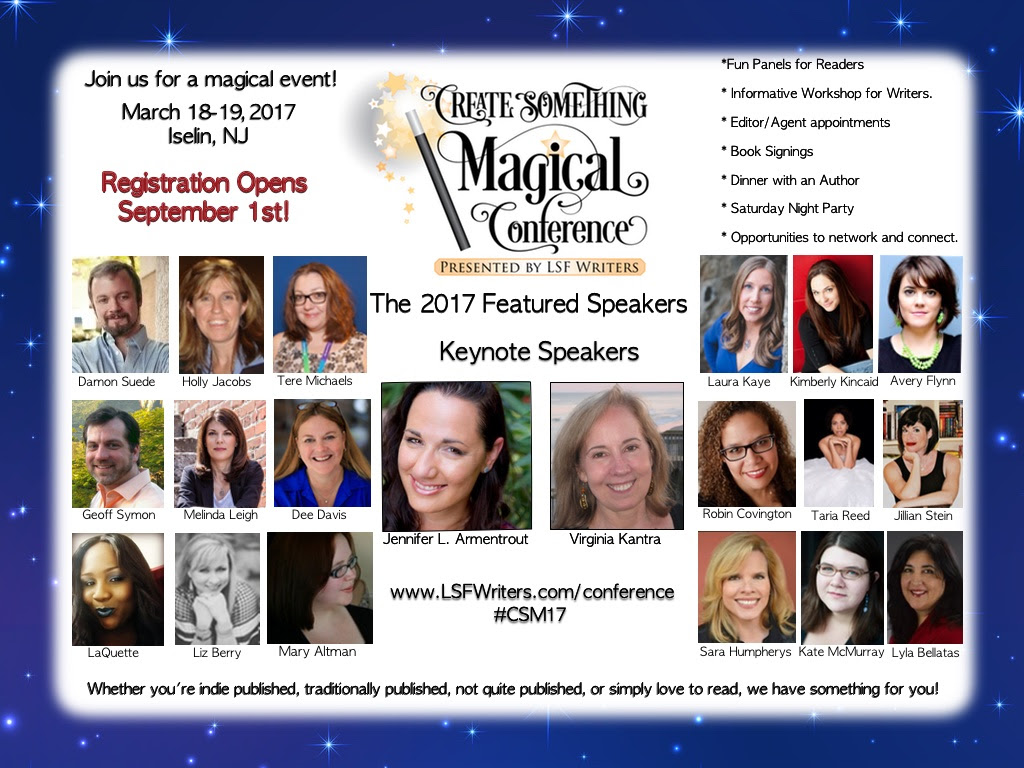
Liberty States Fiction Writers 2017 Create Something Magical Con Registration Opens Sept. 1

untitled

Want to Write? Love to Read?

Mark your calendars for

the 8th annual Create Something Magical Conference.

Whether you’re indie published, traditionally published, not quite published, or simply love to read, in all and all genres of fiction writing, we have something for you. Join us on March 18-19, at the Renaissance Woodbridge Hotel in Iselin, NJ

2017 for a magical event!

LSFW Banner

See Liberty State Fiction Writers for more info!

Methods for your madness

990488Most writing follows a certain form, whether fiction or nonfiction. Newswriting and creative non-fiction are fact-based, humor amuses, biography chronicles a life. Fiction tells an invented story, whereas, genre fiction adheres to certain inherent strictures, ie, mysteries leave clues, romance relates a developing relationship, horror shocks, fantasy world-builds. Readers expect when they pick up a thriller or an autobiography or a true crime that it’ll follow whatever form’s intrinsic to that genre, but what if you want to define what you’re writing even further? This is what I call writing for context, or putting that extra level of specification into your writing–for clarity, for authenticity, to strike the right mood. Shall I explain?

Historical fiction is one of the best examples. Aside from not including an HD TV in your Victorian drawing room, certain phrasing and references will lend you writing more credibility, as well as anchor your reader in the era. The best way to get this is to read works not so much about the time of which you are writing, but from the time. For example, from the 18th century, Jonathan Swift or Henry Fielding, 19th century, Charles Dickens or Mark Twain, early 20th, Sinclair Lewis or F. Scott Fitzgerald.  Pay attention to the cadence of their dialogue, their use of phrasing, their historical references, the position of their wording. He was a hale fellow, or Shall we meet at half-past seven? will lend a certain credence to your writing. Now, no one will expect you to construct your exposition with thees and thous, but if you’re writing about 18th century Quakers, you might expect to see a few of those whiskered words in their dialogue.

Another example is writing in the first person. I find this type of writing gives you the most license to experiment. Take the novel The Curious Incident of the Dog in the Night-Time by Mark Haddon. In this novel he writes from a the perspective of a 15-year-old with Asperger Syndrome. He includes the protagonist’s tics and phobias, sprinkling the narrative with logic and math, numbering his chapters with only prime numbers. By writing with this context in mind, Haddon places us firmly in the character’s mind, and makes the experience resonate long after we put the book down.

There are many examples I could go into to illustrate this principle, but basically, it’s almost like Method Acting, or maybe even a little bit like time travel. As soon as you sit down to write, put yourself into the mind of your character, in both time and setting, and let it lead you down its little garden path. If it’s engrossing enough, your minions will soon follow.


Writers! Seek out your own!

IMG_0114In past posts we’ve explored from preparing for a writing project, confronting the blank page, priming your plot pump, getting past your slumping middle, to wrapping it all up and sending it out the door. But what if you’ve got the will and the way, but you still can’t get your motor started? And what if you’ve got it started, but can’t figure out how to shut it down? Or what if you’re stuck in that sagging middle, and it’s got you so daunted you want to hurl the whole kit-and-kaboodle against the wall? Then maybe it’s time to give both the laptop and the sheet rock a break, because you know what they say: when all else fails–retreat!

No, my dear writers, I’m most certainly not saying you should quit. Five noogies to the head for even considering it! What I’m saying is perhaps you need a change of venue, to step out of your everyday and try a different milieu. Where would you go? Why don’t you try these…

1. Writers Colonies – If you’ve got the wallet for it, writers colonies or residencies are about as close as you can get to literary nirvana. Usually in a picturesque location or town, at a college or camp or hotel, they give you uninterrupted time to write, plot or just stare off into space. Many come with social activities so you can network with fellow writers, some even come with stipends, others you have to qualify for. Check the wonderful website Agent Query for their list of colonies and residencies.

2. Writers Conferences – Every writer should attend at least one a year. I certainly do, have for years, and if you just happen to be in New Jersey in next March , you might want to take a look at Liberty States Fiction Writers’ “Create Something Magical” Conference. It’s for one day, but take the weekend and bookend the schmooze, panels and workshops with some serious writing time. Writers Conferences can range from an afternoon to a week-long series of events, many of them grouped by genre, such as the Romance Writers of America in the summer, or the Backspace Writers Conference in New York this November. Full of workshops, editor/agent appointments, panels, readings, book fairs and the chance to meet some of your favorite authors, if you don’t come out energized and ready to attack the page, then perhaps you’re in the wrong business. Again, here’s another look at Agent Query, and their rundown of upcoming conferences.

3. Book Expo America BEA is one of the premier industry events if you are any way connected. If you’re a bookseller, agent, editor, librarian, educator, book club member, writers’ organization officer or published author you can’t afford to miss it. Held over three days in May, last year in Chicago, but next year back at the Javits Center in New York City, anyone who is anyone in the industry is there. After one hour trolling this convergence of Every Publisher in the Free World, if you don’t feel like closing down that WIP to get in the game, then stay home on the porch. You ain’t gonna be runnin’ with the big dogs.

4. College Literary Festivals – Held by the English Department at a college or university, these usually weeklong events hold readings and signings for writers and readers alike. If you’re alumni, this is a good way to connect with your old professors who no doubt have a line on the writers attending, so you never know who you can meet. I go back to my alma mater twice a year for their festival held during their MFA residencies, meeting many of the visiting writers. I even had dinner with Francine Prose one night, though being one of twelve at her banquet-seating table, I doubt if our conversation went past pass the salt.

5. Create your own – Batton down the home hatches and take off for the weekend, to a vacationing friend or family member’s house, to a off-season cottage by the lake or ocean, to a campsite up in the mountains, or even a bargain-basement afternoon with the laptop or legal pad at the library or Barnes and Noble cafe. Perhaps even send the kids off with the spouse to the zoo and stretch out on the back porch, a glass of your favorite libation at your side, letting all those ideas in your head bounce off the trees, the alleyway, the horizon. It doesn’t take much, just a firm commitment and the time to percolate, and perchance, of course, to dream.
Addiction: Writer

37ac708e8dee8de4ff3e1ecf73ed6944I’ll bet you thought I was going to write something about watching the RNC Convention tonight. Because who’d bypass the chance to shout about those toxic twins of the GOP, Ted Cruz and Marco Rubio, rockin’ Cleveland this eve. Well, sage observer you’re wrong wrong wrong. No idling in deep thought or in front of a television tonight for me. I have bigger fish to fry!

As a writer, you’ve probably had people say to you, “I’d write a book if I only had the time!’ or “Where do you get the time to write?” I’ve heard those gems to the point of distraction, and I usually answer, “When you’re a writer you find the time.” I know I’ve gone over this before, but here it is again–when approaching a project, clear your schedule and set up an immovable block of writing time, make sure your friends and family are aware of that block, and then enforce your boundaries. This is a common sense approach, and most of the time, it works. But what if real life does intrude to the point you find yourself NOT writing for an extended period of time? And when it does, how does that make you feel?

The reason I’m mentioning it is that’s exactly where I’ve found myself. As an academic, especially with the start of school looming, I’ve had a million minutiae to attend to, finalizing syllabi, finishing curriculum, coordinating crazy professor attire, etc., damn near sending me skittering off the cliff of sanity. This can happen to any writer when the noose of family, job or real world responsibilities begin to encroach on your fantasy time (let’s face it; we’d rather live in that world than “reality”. When it does, the worst of the worst could happen–you start not feeling like a writer. You’ve abandoned your routine and as the plot and pages start to fade, an ennui sets in that makes you so doubt yourself, you feel that tenuous identity slip away.

Here’s another thing I’ve said more than a few times: writers write. But if you’re not doing it, how can you possibly call yourself one anymore? If that very statement gives you the shakes, than congratulate yourself: you’re taking yourself–and your craft–more seriously than you realize. And if you are, then to get back into writing like a writer, start thinking like one and prioritize.

Above all, ask yourself how important writing is to your health and well-being. If you feel about it the way I do, you’re not quite right when you don’t write, so you’ll find a way to get it back into your routine. The craziness can’t last forever, so start planning for when things return to normal, and if that means perhaps taking those extra two or three weeks to finish what been occupying your time, then do it or you’ll never be able to concentrate. If you’re able, fix a deadline to restart, but if you find yourself open-ended, then again–ask yourself how important writing is in your life. If you can’t picture life without it, then you must make time for it–during lunch, after the kids are in bed, the first thing in the morning, between episodes of Mr. Robot–but do find some time for it somewhere. There is one intractable rule here: writers write. We are addicts in our own inimitable way, but it’s an addiction, when it’s done well, the world–and your own world–is so much better for.

Now that I have that out of the way–onto the DNC! (Hoo boy, I’m such a liar.)

Get out of my face

Get outta heahDid you ever notice whenever you’re trying to write the world finds its way to your door?  Your phone won’t stop going off, everyone in your family is bleeding, and the house keeps catching fire? Even if you try to sneak in a few minutes at work during lunchtime, there’s always some needy coworker who thinks you’re The Help Desk, Dr. Phil and Google all rolled up in one. When does it stop?

I don’t know about you, but when I’m deep into a project, I usually have forty things vying for my attention, when there’s only one place I want to direct it–into the work. True, you can’t shut down the world, but wouldn’t it be nice if you could? Every once in a while, especially when you’re at a critical juncture, wouldn’t it be nice to scream “GET OUT OF MY FACE!” and slam the door? This is especially evident when you’re at the early stages of your career, when you’re either not yet published or Published Without Substantial Royalty Checks (lot of you out there, I hear you), and very few, outside of your critique partners and maybe your mother, take you seriously. And this goes double if you happen to be female. Hey, I’m not going all sexist on you, but there IS a double standard when it comes to Writing While Woman. We’re still expected to go to the outside, schlep groceries, fold the socks, corral the kids and magically produce dinner. Who was that romance writer who used to haul her typewriter into the laundry room and work while the spin cycle spun? This is what we have to put up with. AND we can’t expect anyone to take over these duties until our future bestsellers actually become bestsellers and we get to hire help. Now, that’s what I call incentive!

Don’t get me wrong. As I said, you can’t block out the world, and you can’t expect everyone to understand your obsession. And Sweetie does give me the time I need (mostly). But for cryin’ out loud, sometime you just have to be a selfish bastard to get anything done, and what’s wrong with that? At least in the creative stage, there’s not much about writing that’s a group effort and there are times when a slammed door is an absolute necessity. And it doesn’t have anything to do with my not loving you or I don’t care the cat barfed on the bed or that you’ll  end up a shriveled husk for wont of a chicken pot pie. Believe it when I say that I won’t love you any less if you disappear for the afternoon. But I’ll love you a whole lot if you allow me to spend just a few hours playing my imaginary friends. Trust me, in the long run it’ll benefit both of us. And you’ll be living with much less insane person.

Now will you get out of my face?

Writing against the rules

IMG_3255I have a friend, a fellow writer who I swap works-in-progress with. I trust her judgment as she has a good eye, and I’d like to think she regards me in the same way. (By the way, the picture above has nothing to do with what I’m writing about. I was on Martha’s Vineyard last week–hence, why no post–and this is a picture of me standing in front of the Aquinnah Cliffs.  Just thought you needed to see it.) But what I recently sent her did not include the laudatory and enthusiastic commentary I had hoped. As a matter of fact, she thought I was writing as if I didn’t know my own character as well as I thought I did, not to mention his motivation and where it fit in the story.  She thought the reaction my character had after an amorous situation was a bit cold, and that I should just let the story happen. But I had also sent the same piece of writing to someone else, and her reaction was totally different: That was hot and sweet with a sprinkle of realism, and that got me to thinking – how much should you let reality intrude upon your fiction?

Many of us think of fiction as an escape, and that writer all should follow some unwritten rules on the road to a satisfying conclusion. This is especially true of romance fiction, as its many readers expect the protagonists to act or react in a preordained way, ie, there is an instant attraction, and that once attracted, the couple should only have carnal knowledge of each other, and most important, the hero and/or heroine should never deceive each other without a very serious, nearly life-threatening reason. Not that what I’m writing is a romance per se, but it does have a very strong romantic overtone, and here is where it gets sticky: my main character breaks one of those rules. And by doing so leads my friend/critique partner to think her acting cold. Perhaps so, but that’s all right, because that’s where the sprinkle of realism comes in (and the fact my other friend got that is why she is my friend. So shallow, me.)

The way I see it, is that people rarely follow a preordained set of rules, so why write them as if they do? Although many have reactions we can deem typical, in reality, things aren’t that cut and dried, so why should I write as if they were? As long as my character is acting within character, and I’m following a certain sense of logic, it makes for better writing, as well as a better story, if I let reality intrude now and then. You have to ask yourself if you can reasonably see your character acting the way she does. Does it make sense to the story line? Does it carry the plot forward? Does it make for a better outcome? If you can satisfactory answer each of these questions, then go ahead and include that bare-knuckled fight, the bus falling off a cliff, the fact that she gets up and leaves him instead of the other way around. Life isn’t always pretty, but there’s nothing more compelling than writing a pretty compelling story. It’s what selling. And what they’re buying.


Hot, Hotter, Hot as F***

Ah, Amour!If you’re reading some of the more popular Romances these days, you may have noticed the sex has gotten a whole lot spicier. Odd to think at one time various works of such classic writers as Henry Miller, Vladimir Nabokov and D.H. Lawrence were banned in this country because of a sexual content which would now barely raise a eyebrow. This is, of course, not to say more lurid works weren’t out there. Ask your grammy if she ever heard of a Tijuana Bible, and if she doesn’t slap your face, she just might surprise the heck out of you. But if books you can now buy from the drugstore spinner are jalapeno enough to singe your fingers, how can you tell the difference between what’s hot, hotter and goodness! gracious! hose-me-down!? Well, here’s a handy little thumbnail to help you sort it all out.

Romance is the story of the journey lovers take to their happily ever after.

Erotic Romance is the story of the sexual journey lovers take to their happily ever after.

Erotica is the story of a lovers’ sexual journey. Period.

So as you can see, it’s not really the sex per se as much as how the sex is used as a plot technique. In Erotic Romance, as opposed to more “traditional” romance, the sex is more defined, ie, a spade is a spade is a spade. Nix the hammer of love, darling, and call it what it is. In Erotica, this concept is stripped (oh, dear – forgive me) of all pretense, and goes straight to the good parts (no flipping necessary).Yet, as in all writing, just because its temperature has gone well beyond the hard crack stage, it doesn’t mean its quality should be compromised. Bad writing is still bad writing. Just because we’re looking to be bad, it doesn’t mean we shouldn’t get it good.


The View From Here

1322856746795_1293238The first person Point of View comes easiest to most students, and to most new writers, so it surprised me one day last semester to receive an essay written in the second person point-of-view. Now if you’re unsure or unaware what second POV is, take a gander at the opening line of Jay McInerney’s 1984 novel, Bright Lights, Big City:

You are not the kind of guy who would be at a place like this at this time of the morning. But here you are, and you cannot say that the terrain is entirely unfamiliar, although the details are fuzzy.

This slice of hipster lit from the ’80s employs a liberal use of the pronoun you, and that’s what made it such a topic of literary conversations at the time. Writing second POV is uncommon, as it requires the reader not only to step into the head of the protagonist, but into his very character, not an easy to do, and often, it’s done badly. Consequently, it’s not something I come across often, and it’s always a surprise when I do (especially from students!) So, what of other POVs, namely first and third? Is one more popular than the other? Or more difficult? And why?

Hands down, the most common POV is third. Third POV may be omniscient, in which the thoughts of  every character are open to the reader, or limited, in which the reader enters only one character’s mind at a time. Third POV allows the author to lend his or her own voice to the expository passages, enabling more stylistic freedom, as well as getting into the heads of several different characters to access their most intimate thoughts. Still, there can be danger in all this. Too many POVs can dilute the writing, cluttering it with too much information from secondary characters that have no bearing on the plot. A best practice is to keep POVs to the main characters, two or three maximum. Another pitfall is head-hopping, shifting from one character’s POV to the others without a scene or chapter break. Head-hopping can be confusing but even worse, it lowers the tension, and the reader loses that fluttery anticipation of experiencing the plot unfold like a safecracker chipping away at a combination lock. Still, third is the easiest and most popular POV, allowing both the writer and the reader rich and expansive prose.

First person point-of-view, on the other hand, is even a more intimate experience, as a character narrates the story, their thoughts and observations depicted in his or her own dialect, colored by their own worldview. The pitfall in this is that worldview is limited to their own, and they can’t possibly be privy to information outside of their own sphere. And because the reader can only know what the narrator knows, and that worldview may be tainted by perception or prejudice, they run the risk of being taken an unreliable narrator. An example of this is when prose is written in the POV of a child, or someone with diminished mental abilities as William Faulkner did with his character Benjy in The Sound and the Fury. Even so, it’s a POV I’ve written in often and one I always enjoy reading, as it adds a realism and anticipation to the book, when the reader becomes one with the main character.

Whatever POV you choose, it should be one you’re comfortable with, and one you shouldn’t let the market dictate. There are schools of thought that say the first-person point of view is outdated, but two of the last few years most popular books, Water for Elephants and The Help, were both written in first POV, the latter written through the eyes of four women. And then there’s those who say head-hopping is perfectly acceptable. My opinion is it’s just lazy writing. After all is said and done, just write the best book you possibly can, and if it is, it’ll find its way into your readers’ hands.


What am I doing? No Effing idea

6c1e0c571b3446778fce1e30f6a1de9eIf you regularly read this blog you’ll recall I finished a book a couple of weeks ago. So yesterday, being the self-flagellating writer that I am,  I started a new book.  This one is going to be longer than the last one, over 100k words and a much more intricate plot. Normally I fly out the gate, the words shooting out of me like verbal vomit. (Okay, gross allusion, but think the alphabet, not masticated grilled cheese and tomato soup). Most of the time, the first three chapters are the easiest I write as I always have the opening in my head, and within a couple of days I usually have them down. But with this book? I spent all day and ended up with half a page. Half a page! I should be totally ashamed of myself. I once wrote a 50,000 word book in five weekends. So what’s the deal?

A long time ago I discovered the cure for Writer’s Block, or rather I discovered it doesn’t really exist.  So-called writer’s block only happens because you’re doing something wrong. It could be any number of things from writing outside your character’s logic, to veering too far from the ultimate goal. But I found the surest way to “cure” it was to turn things 180 degrees around, to give your character a perspective from the other side. If they’re going North, have them go South, if they’re running away from something, have them run toward it instead, don’t let them get that promotion–get them fired instead or better yet, quit. Have them act instead of react or visa versa. You’ll never get anywhere by skating the perimeter. Bust through it and see what happens.

But I digress. Because I don’t have Writer’s Block. I have something so much worse. I have stared this new project right in the eye and I have come back intimidated.

Has it happened to you? Have you had this terrific plot rolling around in your head so you do all the prework, plot the story to two sequels then clearing your calendar, you finally sit down to write. Then all at once the enormity of the thing starts looming over you like the Empire State atop Everest and you start cringing, that expanse of white screen as terrifying as an Arctic blizzard, and you wonder how the hell you’re ever going to get out. So now what?

I suppose I should take the advice of a friend of mine, so simple it almost seems ridiculous: Just write the book. Just write the book. Just write the book. She has it on a sign over her desk so she never forgets it. Just write the book because if you don’t, like a car that never leaves the driveway you’ll never go anywhere, and you’ll sure as hell never get the book done if you don’t.

So I will just write the book, but that in no way signifies I have any idea what I’m doing!


I write, therefore I wait

giphyWriters write, is what I always say. And as a practitioner of the art, I not only completed one novel recently, but just last week I finished revising another one that had been cooling in my hard drive for a couple of years now.  I did this just after closing out what is commonly known in English academia as The Living Hell That Is the Final Essay End-of-Semester Clusterfuck. (Don’t get me wrong–I love my students. But there’s just something mind-scrambling about spending every living, breathing, waking moment with a red pen in my hand.) After that I thought I’d I’ll give my brain a few weeks to chill, maybe get ambitious for that mile-high to-be-read stack of books  on my end table, or scrape off that pile of unidentifiable goo bridging the gap between the leg of my desk and the wall. Or I can continue on with that new series I’ve been tossing around for awhile now. And I would, if I wasn’t fretting out those two literary babies I just sent out into the world while I molder here in Submission Limbo.

If you’ve submitted, whether query, proposal or full ms. to an editor or agent, then you know what I’m talking about. Because the result is you get to wait and wonder how it’ll ultimately turn out, while going half off your nut obsessing about it. From a query: will they ask for a proposal? From a proposal: will they ask for a full? And after they do, oh Christ, that’s when the real quivering commences, as your hopes get so high you start cruising the Tesla site and actually saying things like, “Hell yeah the Makers Mark’s on me!” And it doesn’t matter if you’ve sold before, and it doesn’t matter if you have an agent. Selling before only makes you feel worse, as an agent may get your foot in the door quicker, but it also makes it slam even faster. So what’s a writer to do?

Two things, actually: cultivate a nice, cushy mental block, and keep writing. Send something out, and then turn around and get to work on the next project. My agent and I have an agreement: she only contacts me if she has news. By news I mean, if it’s good. This approach doesn’t work for everyone, as I know several writers who prefer to track every submission. But the way I figure, if I wanted to do that, why would I need an agent? For me it’s better to focus on the big picture (read: the Tesla). Yet…

Look, there’s really no easy way around it. Waiting blows. But I’d never get any writing done if all I did was focus on what I’ve written and not on what I’ll write. So I’ll linger in Submission Limbo and bide my time  a little longer, as running with the big dogs will beat sitting on the porch any day.