Tag Archives: Writing

Why we love those bad, bad boys Revisited

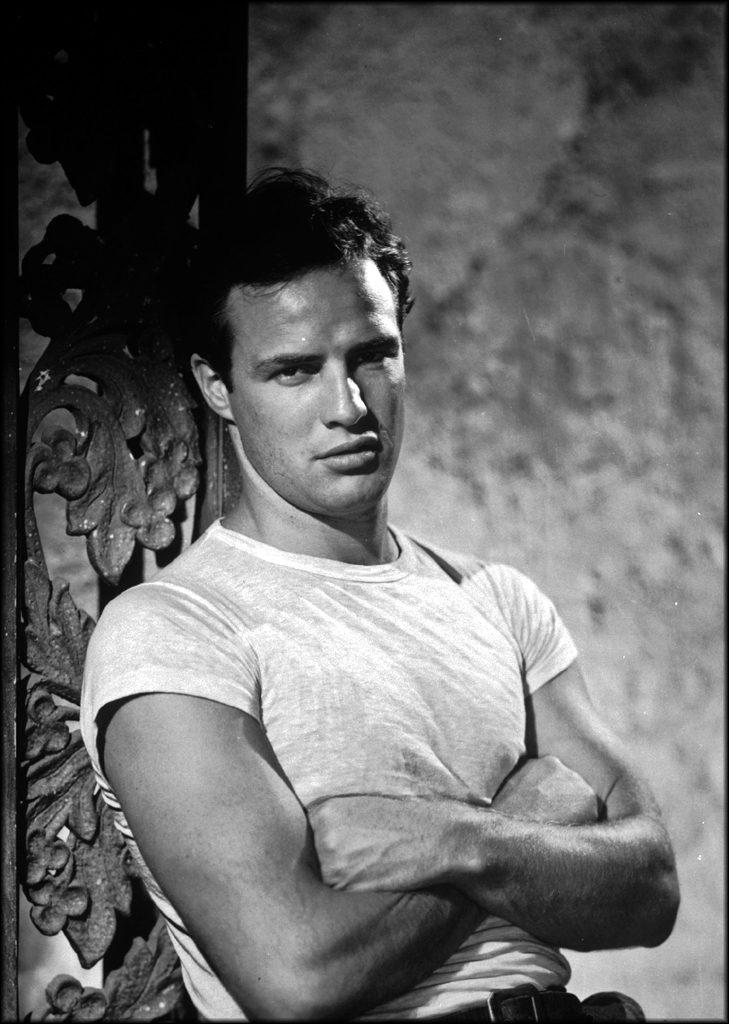
marlon7

Yes, another revisit. I’ve been busy! I promise, I’ll have a new entry next week! But this is for all you romance writers out there.

We’ve all read about them. Those incorrigible, gorgeous rakes who don’t give a damn about stealing your company, raiding your trust fund, double-crossing the best friend or breaking your heart. He’s the one with the best lines even though they slice to the quick, telegraphed from a mouth crooking sardonic and eyes that flash and burn. He’s always the snappiest dresser with the shiniest shoes and the most expensive jewelry, more often bought with your line of credit. If he gets in a fight he wins without mussing a hair, and that slight nick high on his cheekbone only makes him more dashing. His voice is smooth as silk and it rumbles through you like an electric charge, as he’s talking you out of your clothes and everything in your wallet. He’s on everyone’s A List, is invited to all the best parties, frequents the finest restaurants and clubs, and is only seen with the most beautiful woman. He has the tightest abs and the broadest shoulders, is tall and lean and impossibly gorgeous. He’s the consummate lover but he’ll never fall in love, yet he’s what every woman wants and what every man wants to be. In film he’s Gordon Gekko the ruthless arbitrageur of Wall Street, in romance, he’s the pitiless rake, Sebastian, Lord St. Vincent, in Lisa Kleypas’ wonderful novel, The Devil In Winter. And for all their cunningly manipulative ways, we are unabashedly drawn to them like magnets to metal filings. We worship them, adore them, envy them, lust after them. Only to be cut down and debased and betrayed over and over again. So why in the world are we continually drawn to this bad, bad boys?

Because oh…how we love to see them fall!

And when they do, it’s usually spectacular, a crash and burn of epic proportions. But then we get to witness the most marvelous thing– their redemption–and what a fascinating thing that is, watching these fascinating creatures evolve, scrabbling their way back to the top–and to us. It’s a precipitous climb, full of switchbacks and reversals, but when they finally learn their lesson, we get to wallow in their devotion, their bad, bad ways making them oh-so-good exactly where we need them.

Romance writing is all about the resolution of conflict between two protagonists so love can bloom, and there’s nothing like a rake whose odds are so out of favor, it almost seems impossible he’ll ever end up redeemed. But it also  makes the most compelling reading. Give me a good old bad boy any day, as they’re the most challenging and certainly the most fun. Because as everyone knows, that’s all we girls really wanna have anyway.

Diagnosis: Writer – Five Sure-Shot Symptoms

vintagetypewriter_93579-758x485Okay, I’m being lazy. I’d rather repeat this old post than think of something original. But it’s a good post, and I’m right in the middle of revising something I wrote years ago, so this re-posting an old post fits perfectly into my writing life right now. Even so, it does offer some valuable advice, not only to you, but to those irritable people who keep interrupting you to say, “What is it you do in that room all day’?” Arrrgh! So this should help you answer them. Because the first step to a cure is to admit you’ve got an addiction. But in this case, a very good one. Read on…

No, you’re not crazy, even though your friends and family think you are. Even so, you have to admit that at time, you do seem a bit “off.” Still, how do you measure crazy against what accurately borders on obsession? I was thinking of this last weekend while lunching with some fellow writers, wondering whether they’re afflicted with similarly bizarre affectations, or if I was I suffering in silence. Odd or not, it’s made me realize that dammit, I must be a real writer, because although I’m not cutting off an ear or anything for my art, I sure am suffering some peculiarities. Such as:

1. Post-it Note Addiction – It’s true. I carry them everywhere. I have pads of them on my desk, in my purse, in the pocket of my course binder. I whip them out to jot down lines of dialogue, character descriptions, plot lines–even the premise for this post. They’re all over the place in my office, and when I’m on  the road and inspiration clocks me, I jot down my genius and stick them to the inside of my wallet so I don’t forget. By the way, they’re also good for shopping lists, as you can stick them right in front of you on the inside of the shopping cart.

2. Drinking Hot Liquids Cold – During the winter months I usually have a cuppa something at my elbow while I’m writing, but I have to tell you, I can’t remember the last time I actually sipped it while it was still hot. Usually the cream’s left a sheen on the coffee, or the tea’s soaked down the string to the tag, an “accident” puddling on my desk, whatever’s in the cup long, gone cold. The opposite effect is true in the summer, when I never seem to sip anything cold: the ice just a memory, the glass dripping condensation. I should probably just yank a bottle out of the cabinet and forget about it. Either way, it all ends up the same place: room temperature.

3. Vitamin D Deficiency – My last routine blood screen had everything come back normal except my Vitamin D level. Apparently deficiencies of this vitamin, which is created by sunshine, can cause depression, chronic fatigue, weight loss (I wish), diabetes, heart disease, stroke and osteoporosis. In addition to a disease I thought went out with the nineteenth century–rickets! “It’s not unusual to see decreased Vitamin D levels in the winter,” my doctor had said. “But yours? Don’t you even step out on the porch?” All right, I guessing the LED glow from my laptop isn’t enough, so I suppose it’s supplements until the snow melts and I’m hitting the sidewalk again.

4. Plot-related Memory Loss – Has this happened to you? You’re driving along, trying to work out what exactly Protagonist A is going to leave on Protagonist B’s doorstep, and the next thing you know you’re sitting in the parking lot at work, with no idea how you got there. Or you’re in the shower and you’ve just thought of the perfect setting for your heroine’s vacation. But there’s this bottle of conditioner in your hand, and you can’t remember if you washed your hair first. Whether you’re staring at blank walls or losing threads of conversations, it’s not early dementia–it’s Plot On the Brain. And trying not to think about it only makes it worse. Better to lock yourself in the closet and get it down and over with.

5. You Do It Anyway – This I have found the most telling. You’ve written a bunch of novels, a dozen short stories, more than a few essays, innumerable blog posts, even kept a journal for more years than you’d care to own up to. And although you’ve had some limited success, though nowhere near where you’d like to see yourself, you keep doing it. You finish one piece then start another, because you know if you don’t your axis will tilt and forget the Vitamin D–you’ll feel a deficiency worse than if all the chocolate in the world suddenly disappeared. You can’t help yourself, even on the days when that rejection shows up in your inbox, you still want to do it. You’ll cry and curse and hate the world for stopping you from doing what you can’t seem to give up. But then all of a sudden that perfect line plants itself in your head, and you’re back to doing it anyway. You’re so pathetic. Maybe. Maybe not. But oh man, sometimes it’s such a bitch being us.

Okay, enough whining. Back to work.


Writing in the time of pandemic

I haven’t said much about the virus in the months that we’ve been locked down and out of our normal lives. Mostly because I’m not one to give oxygen to something so disruptive, as maybe it’s best to ignore the worst and carry on. But it has been disruptive and it has been the worst. I haven’t been on campus since Spring Break, and teaching college remotely is a bullshit substitute, long lost of it’s novelty of biz-cahz uptown and yoga pants downtown. I miss the the color and variety of campus life, I miss the one-on-one interactions with my students, I miss my zany colleagues, and let me tell you, I even long for those interminable committee meetings. (Even shrinking my Zoom screen to play “Spelling Bee” or Free Cell is dull next to inter-departmental drama.) As bad as my campus being compressed to the confines of my 10 X 12 home office, that’s not the worst. Not by a major long shot. It’s the loss of my writing mojo.

One would think with the shrinking of my social life, I’d revel in the time left over to create. That all those evenings and afternoons I spent in exterior pursuits could now be devoted to the interior ramblings of my imagination. If it only were that easy. After spending the greater part of the spring and summer polishing off and perfecting my latest novel to send it out on the market, I’ve been made painfully aware of the dismal prospects of getting it sold. One would think that editors, locked out of the offices, the cocktail parties, the author events, etc., have nothing better to do than read and revel over each and every one of our magnum opi. But let me tell you, that is an assumption I was a fool to make.  This business is tighter than ever, and with so many people self-publishing, mid-list books are no longer much of a priority. Not that I think selling isn’t still a possibility–oh don’t get me wrong. Persistence always pays out in the end. I’ve sold before, and I will sell again. But the unoccupied mind is a fertile playground for despair, and one imagines all kind of scenarios, and most of them hardly uplifting. And that wreaks havoc on creativity, especially when you’re trying to work on The Next Greatest Thing. You’d be surprised what a frenemy the Pandemic becomes, as a wholesale excuse to flee the dreaded Empty Page for Netflix. (Watched “Queen’s Gambit” in just two sittings last week!) So what does one do when the writer no longer feels like one?

You want answers? Comfort? Companionship? You’ll get none of it out of me. Well, maybe that’s not true–companionship maybe, as I have a feeling I’m not in this alone. Although most fiction writers pride themselves on the ability to build vibrant worlds out of nothing, they still need reality as an engine for creativity. And because of that, we’ve also been known to live too vividly inside our heads conjuring up all kinds of horribleness. I’ll never finish this book. Who am I to think I’m a writer? No one will ever buy this crap. If I send this out it’ll only get rejected. I have writer’s block. I’ve lost my imagination. I can’t write. I never could. I suck.

Yeah, that’s me, and I suppose that’s been you at one point or another, and never more than now. But maybe we shouldn’t be so hard on ourselves.  These are extraordinary times. I’ve even heard them compared to World War II in the sacrifices we’ve had to make, the pain we’ve had to endure, the doctors and nurses and essential workers our fighting men and women at the front. It’s hard to concentrate on fantasy when a trip to the grocery store has all the potential of making our worst nightmares come true. Maybe we need to give ourselves a break, redirect all that bad energy into good. Give grandma a phone call. Send a tray of cookies to the local ER. Drop a box of groceries at a food bank. Donate to your favorite charity.  Your writing life will come back to you. There are others whose loss is much more concrete.  In the meantime, between now and the vaccine, there’s still room enough in our heads for hope–and even perhaps a dream or two.

HUMOR FOR COPY EDITORS (AND PROOFREADERS, ENGLISH TEACHERS, ETC.)

• An Oxford comma walks into a bar where it spends the evening watching the television, getting drunk, and smoking cigars.

• A dangling participle walks into a bar. Enjoying a cocktail and chatting with the bartender, the evening passes pleasantly.
• A bar was walked into by the passive voice.
• An oxymoron walked into a bar, and the silence was deafening.
• Two quotation marks walk into a “bar.”
• A malapropism walks into a bar, looking for all intensive purposes like a wolf in cheap clothing, muttering epitaphs and casting dispersions on his magnificent other, who takes him for granite.
• Hyperbole totally rips into this insane bar and absolutely destroys everything.
• A question mark walks into a bar?
• A non sequitur walks into a bar. In a strong wind, even turkeys can fly.
• Papyrus and Comic Sans walk into a bar. The bartender says, “Get out — we don’t serve your type.”
• A mixed metaphor walks into a bar, seeing the handwriting on the wall but hoping to nip it in the bud.
• A comma splice walks into a bar, it has a drink and then leaves.
• Three intransitive verbs walk into a bar. They sit. They converse. They depart.
• A synonym strolls into a tavern.
• At the end of the day, a cliché walks into a bar — fresh as a daisy, cute as a button, and sharp as a tack.
• A run-on sentence walks into a bar it starts flirting. With a cute little sentence fragment.
• Falling slowly, softly falling, the chiasmus collapses to the bar floor.
• A figure of speech literally walks into a bar and ends up getting figuratively hammered.
• An allusion walks into a bar, despite the fact that alcohol is its Achilles heel.
• The subjunctive would have walked into a bar, had it only known.
• A misplaced modifier walks into a bar owned a man with a glass eye named Ralph.
• The past, present, and future walked into a bar. It was tense.
• A dyslexic walks into a bra.
• A verb walks into a bar, sees a beautiful noun, and suggests they conjugate. The noun declines.
• A simile walks into a bar, as parched as a desert.
• A gerund and an infinitive walk into a bar, drinking to forget.
• A hyphenated word and a non-hyphenated word walk into a bar and the bartender nearly chokes on the irony.

DUH! it’s nanowrimo!

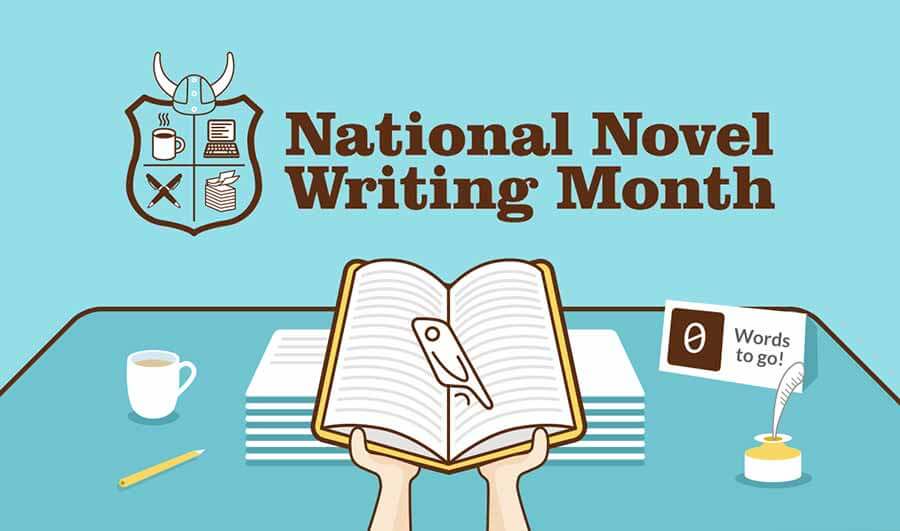
I CANNOT believe it’s 18 November, and I forgot to give my annual plug for National Novel Writing Month, otherwise known as NaNoWriMo! Maybe because I’m so swamped with grading and thesis reviewing I don’t have time to write myself. Fine writer I am! I still should find the time to jot down something (well, maybe that’s what THIS is. But still. NaNoWriMo is still the greatest thing ever, because even if you’re not planning on starting a new novel, you can still use it to continue on with your current work-in-progress, spiff up an old one, or give yourself a virtual kick in the pants. Or as they put it…

Every story matters.
Let’s start writing yours.

Writing a novel alone can be difficult, even for seasoned writers. NaNoWriMo helps you track your progress, set milestones, connect with other writers in a vast community, and participate in events that are designed to make sure you finish your novel. Oh, and best of all, it’s free!

Yes, free is always a good thing. And so is the sense of community you get . There are local chapters as well, so you can keep that community spirit all year long, with the great events they sponsor. There’s even Camp NaNoWriMo for the youngsters. In any event, it’s never too late to get started.

Now–get that butt in the chair and start creating some genius!

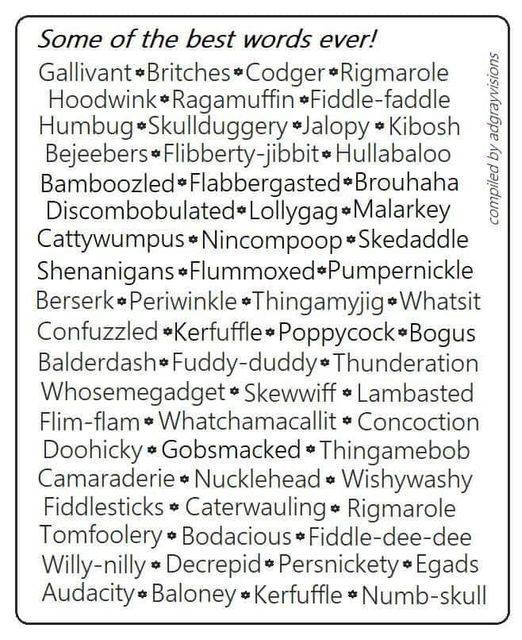
Throw away your thesaurus and use these words instead

Yes, Biden won. He did. That’s reality. (YIPPEE!! btw). But at least for the present, I’m tired of being a pundit. I’d rather be a writer instead. But I’m too exhausted by the last few weeks to rub two coherent thoughts together (See? Even splitting infinitives). Then I saw this on a social media site, and it’s exactly what I need today. See how many of these words you’ve actually used in your writing. I for one have used several, but my absolute favorite of the list has to be cattywumpus. I have no idea what it means, maybe something akin to kerfluffle, but I’m definitely going to have to find an occasion to use it.

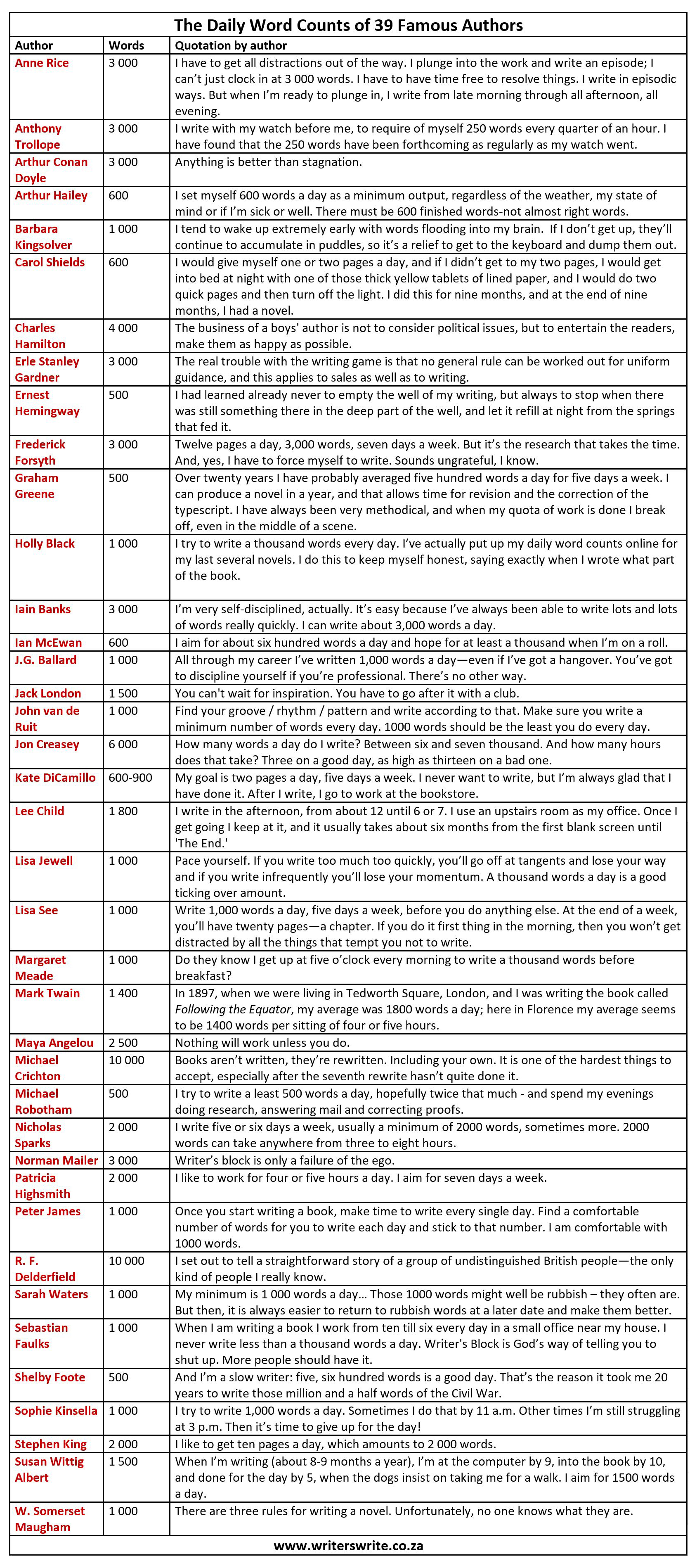
Word counts that make you feel inadequate

I found this online and it made me feel so inadequate (temporarily) that I just HAD to share it with you. I hope it either spurs you into action, or you’re already so infinitely superior you scoff at such meager amounts. Either way, get to your keyboard, you’re wasting time with me.

writing outside your brain

I’m sure you’ve had this happen to you. You have this fantabulously good scene inside your head, practically playing like a movie, so you run to your keyboard and write it down, the words shooting to the screen like rivets, convinced you’ve just birthed genius. Exhausted by the effort, you save and exit, pondering the multitude of ways you’ll expand on it next time. But when you go back to it, whether the next hour or day or week, it reads like something out of a kindergarten class. The transitions make no sense, the characters are running into each other, the continuity seems out of a time warp. What happened to your genius?

The inability to write outside your head is one of the most common causes of angst I see with my young writing students. Oh–no angst for them–for me is what I mean. They don’t see anything wrong because until I point it out, that scene is playing in their head just as fresh as if the action were taking place right in front of them. But what they don’t realize is that there’s blanks they have to fill in, like facial expressions, reactions, settings, time of day, transitioning from one place to another, who this person is they’re suddenly talking to and how they relate to the scene. Then there’s technical things that may relate to a character’s profession or action they’re currently in. Like what is that tripod or data set or NMR tube is for. Sometimes what a writer doesn’t realize is your reader may not understand what comes so clearly to you. I say to my students that sometimes you have to explain things like your are writing to kindergarteners. With the average news site at a sixth grade level, sometimes you just have to dip a bit lower.

This doesn’t mean you have to dumb down your writing. That’s not what I’m getting at. What I’m saying is that sometimes your writing needs you to step back and let it simmer for a little while, so when you go back to it you can look at it with a fresh eye. Sometimes you need to forget it just a bit, to see where you need to fill in the crack. Like mortar, it’ll only make it stronger.

Tips from the MFA Pit – Part 9

Hello class! It’s a new school year, and with it comes a new edition of Tips from the MFA Pit, actual advice to actual MFA students. This edition is on Deep POV versus Internal Dialogue, and all advice is from my brain alone, and NOT the official voice of anything outside my head. So please feel free to add a large grain of salt!

Let’s look at Deep POV before we get to Internal Dialogue. Both are intensely personal. You’re literally putting yourself into the character’s shoes. When you write within a character’s POV, you can only see what they see, and all the other character’s actions are just what that character can hear or observe. Deep POV goes beyond that. It’s what they feel, how they react, their gut feelings of pain, pleasure, anger, calm. It’s also how they react cognitively, psychologically and physically to another person, a situation, what’s said, observed, etc. For example:

Lauren opened the front door, the hills rolling out before her. Her fingers tightened around the knob and her pulse raced, tears flooding her eyes as Tom’s car rounded the last curve. Her heart burst with joy. He’s here.

If you’ll notice, no one outside Lauren herself could feel her pulse racing or burst with joy. They could observe her fingers tightening or tears flooding her eyes, but what she feels internally – or the reasons for it – is hers alone. Then we come to the last sentence – He’s here. That’s Internal Dialogue. It’s things that could be said orally, but are kept inside the character’s head.  It’s the difference between feelingJoey knew there was no way he could talk his way out of this – and saying to yourself – I’m sunk.

A best practice, at least the way I see it and no way is this a rule, is to use Deep POV more and keep Internal Dialogue to a minimum. Using Internal Dialogue too much is like “telling” not “showing.” When you’re in a character’s POV, you want to know how they are feeling inside, or what would be the point of being in their head? Usually it’s best to keep the internal dialogue short so it has more of an impact, and most publishers place it in italics to separate it from the Deep POV. It is ALWAYS limited to the character whose POV you’re in, and it is always in first person.

Words of wisdom indeed! Till next time — keep writing because ===> WRITERS WRITE!

De-inspiration

I’m back again after a long non-vacation, as what constitutes a break these days? When we get one, we’re largely in the same place, revolving in the same space we’ve been taking up for close to six months now. The college I teach at has gone remote, except for the fewest of disciplines that must meet in on campus, abet physically-distanced, masked, temperature-checked and documented for contact tracing. I get to work behind the desk that’s long spawned my source of income–and served as a jumping off point for my attempts at writing beyond my pay grade. (Hey editors — if you’re out there listening, I’m still at it.) After awhile you get to wonder whether it’s all worth it, writing in this environment. You wonder when it will all lift, and with it your mood and your inspiration.

Funny, that months ago I found myself falling into a rut. I’d get up, go to work, come home, grade grade grade (the real work of a writing teacher), attend to household things, write. In between I’d sprinkle in going out to dinner, meeting up with friends and family, shopping, movies, and occasionally, there were conferences, lectures, and club meetings, and a sprinkling of short vacations. Most were repeat events, things I’ve done in the past, but however enjoyable, there was little variation. Oh! for something exciting to happen! I’d lament, as anything out of the ordinary would be welcome to shake me out of the slog my life had become. Then–and I remember the exact day, March 13, the last day before Spring Break was to begin–I couldn’t shake the nagging feeling that I ought to stay home. That day was a Friday, and the day itself couldn’t be more portentous. It was more or less the day New Jersey drew into itself and suddenly the world, my world at least, shut down.

For six weeks I didn’t leave my neighborhood, the first week not going further than the end of my block. After two weeks in, my husband an I took a ride to a dairy farm a mile or two away. The early spring dampness hung chilly and dank over the fields, doing nothing for my mood, but it got me out of the house, so even the manure smelled sweet in its rankness, but at least it was outside and not in my backyard. Without anywhere to go, I read and read, binged Mad Men, Schitt’s Creek, and Outlander, kept to a rigid exercise schedule.

I never cooked so much in my life, big complicated meals full of sauces and cheeses and all kinds of veggies, via Shop Rite at Home. We got so many deliveries from Target the back of my husband’s van became filled with cardboard boxes that never did make it to the packing shop who always had taken our used boxes before (back before they believed they carried the virus). My kitchen and closed in porch filled with fresh fruits and vegetable from another local farm where you texted in your order for curbside pick-up, and because of shortages all around, our meals consisted of what we could glean. When the glean was fat I’d make cookies out of whole-wheat flour, filled with dried fruits, coconut and dark chocolate, energy food I’d tell myself. I made heavy pound cakes I’d toast and slather with butter, homemade ice cream, and soups so thick a spoon would stand up. I’d scour The New York Times cooking section for new and ever-complicated recipes, which I’d start preparing not too long after lunch. I’d make banana cake, rice pudding, home made apple and cranberry sauces. At one point I realized I’d made every bit of food we put in our mouth for two months straight, and the idea so horrified me, we planned on taking the enormous step to get take out for my birthday in May. Takeout Chicken Francese had never been so good.

Then as the weeks wore on, somehow the pressure got a bit lighter. I ventured out to the supermarket for the first time, left the state to visit my sister, took a day trip to the shore,  finally got my hair cut. While the virus picked up in other parts of the country, it calmed down here in New Jersey, and life returned to a kind of new normal. We wore our masks, kept our distance, Zoomed, and washed our hands, and spent a lot of time outside. Before long I submitted one book to my agent, then made the decision to start another next. Which leaves me where I am today, thinking: How does one write in a pandemic?

I’ve discovered something odd: that as much luster as my day-to-day has lost, that no matter how many times I’ve been depressed and lonely, wondering when the perennial touchstones of my life will return, I know that retreating into a world I create will never fail to bring me joy. That losing myself in that world brings me purpose, knowing it is possible to venture into faraway places by never leaving your desk. I’ve learned that after all these years of varying success, writing is something I’d still do even if I never have any success at all. I know that doesn’t make any sense, but maybe it really is more about the journey. That’s not to say I wouldn’t argue with an eventual destination or two. Even amidst this pandemic, with all its restrictions, there are still places I’d like to go.