Tag Archives: Writing

Spiff that ‘script!

Remember when you were in college (or even high school for that matter) and you took a class called CompositionWe all had to follow some kind of standard formatting for our essays, whether it be standards set by the MLA (Modern Language Association) or APA (American Psychological Association).  It’s no different in the world of publishing. There’s a “somewhat”  standardized type of formatting writers follow when submitting work to be published. I say somewhat because all manuscripts, at least in their final form, are subject to a house style which is tailored to a publishing house’s  individual preferences. But you can’t know that unless you’ve been sold, so to up those chances, you’ll want to make your manuscript as clean and professionally-presented as possible. You may not think formatting has a place in this, as your story, your ideas, your own unique voice will supersede anything as inconsequential as paragraphing or indents or the proper use of voice tags. But first you have to get that editor or agent to read your work. And if you’re making it too difficult for them to decipher what you’re trying to say, you may never get them to read past the first few lines.

So make it easy for them, beginning with a few basics that are a part of ANY manuscript submission—fiction, nonfiction, poetry, or otherwise.

  • Make sure your manuscript is the best it can be. Close all plot holes, make sure it has a catchy beginning and a satisfying ending, that your characters are compelling and human. That’s for another workshop, but you do want to make sure you’re happy with your manuscript before you send it off.
  • PROOFREAD! Correct ALL spelling, punctuation, and grammar. This goes without saying.
  • Be familiar with where you’re submitting. Check the publisher’s/magazine’s/journal’s submission guidelines for style and formatting. If you’re sending to a particular editor, check to see if they have an individual preference. I worked with a publisher once who did NOT like semicolons. I had to eliminate all from my manuscript. Most times you won’t know this in advance, but if the info’s out there, it’s up to you to find it. Plus it gives you an advantage, the more your know.
  • Check to see if the publisher/magazine/journal is accepting electronic or paper submissions. They may have different formatting guidelines for each. Most now use electronic submission, but there are still several out there that only take paper, and there are differences.

Okay, so you have your manuscript all spiffed up, and you’re now going to prepare it for submission. What would a properly formatted manuscript look like? I want to caution you that agents and editors as well as publishers, etc. may have different formatting guidelines, but most of what I am showing you is the general consensus of what an ms. should look like, and this is what has worked for me when I submitted.

The publishing industry standard is MS Word, 12 point font (usually Times New Roman). The entire body of the manuscript should be double-spaced.

TITLE PAGE

  • TOP LEFT –  Your name and all contact info, including address, phone number and email in single space.
  • CENTER, MIDDLE OF PAGE – Title of work in bold and all caps
  • CENTER, SKIP A LINE – Genre of work with approx. word count
  • CENTER, SKIP A LINE – the word “by” (in small letters)
  • CENTER, SKIP A LINE – Your Name
  • BOTTOM RIGHT – the word “Contact:” followed by agent’s name and all contact info in single space (skip if no agent)

FIRST PAGE OF MANUSCRIPT

  • TOP LEFT IN HEADER COMMAND – LAST NAME/Title of Work (written like that.) If the title is long, just use the first few words. You need to insert Header in “Header” so this info appears on each page.
  • TOP RIGHT – Start page numbering, starting with pg. 2, using “Insert Page Number” command so pages automatically advance. Leave the title page blank by using the command in Word.
  • CENTER, SKIP FOUR OR FIVE LINES  – TITLE OF WORK – in bold and in all caps,
  • CENTER, SKIP A LINE – the word “by” (in small letters)
  • CENTER, SKIP A LINE – Your Name
  • CENTER, SKIP A LINE – Again, Genre and word count
  • CENTER, SKIP A LINE – Chapter One
  • CENTER, SKIP A LINE – Title of Chapter (in italics, if you’re using one) The chapter number and title of chapter are open to style.

BODY OF MANUSCRIPT FORMATTING

  • Indent each new paragraph. For ease of use, I use on tab
  • Indent one tab for each new speaker or when speaker changes
  • Italics for internal dialogue
  • Capitalize the first letter of each word for Names
  • Capitalize the first letter of towns, cites, states, countries, streets, etc., proper nouns and copyrighted names and terms
  • Capitalize the letter I when you’re using first person (you’d be amazed how many times I see it isn’t)
  • Encase dialogue “In quotes”
  • Follow this formatting for voice tags: “I’m not going,” she said.  “You’re not going?” he asked. (Comma after last word, followed by the end quotation mark, followed by the voice tag (she said, he asked) followed by a period, or additional info. The voice tag is part of the sentence.  Do NOT add an extra space after the quotation mark, or Word will automatically capitalize the following word.
  • Use * * * * * for scene changes within chapters, or # for change of POV or impact within chapters.
  • End a chapter by INSERT PAGE BREAK command so the next chapter will start on a new page,

So that’s what’s worked for me. A clean manuscript will keep them reading, but a sloppy one is just one keystroke away from the delete button. Keep them as far away from it as possible.

Writing’s like a candy allusion, amiright?

dark-chocolate-vanilla-caramels-with-sea-salt_2Recently a friend sent me a manuscript she was reworking after having received a so-called “good rejection” from an editor. In case you’re not familiar with such rejections, that’s when the editor thinks the submission is good enough to warrant another look after some changes are made. Sometimes the changes are suggested, sometimes not, but most editors do include some illuminating commentary, and if you have to receive a rejection, they’re decidedly the best kind. This particular editor didn’t offer anything specific other than she’d like to see some more insight in the beginning, and perhaps something a bit incendiary a little farther along.  Well, not only did my friend comply–she did so in spades, injecting enough plot complications this no-longer sagging saga’s got more twists and turns than a whole bag of Twizzlers, and boy-oh-boy does it snap. But this reworking also leaves her with another wholly unintended consequence: she’s created a Genre Cocktail. Though that’s not necessarily a bad thing.

So what am I talking about? Okay, let me use her story as an example. She started out writing Romance, and the story has all the components: meet cute, solid conflict, steamy couplings, de rigueur happy conclusion. Though to keep it interesting, she tossed in a bit of suspense–a medical mystery, an employee theft, a woman on the run. But when the editor found it lacking, she heightened the stakes, adding a red herring, jaw-dropping duplicity, corporate espionage, and a breathless chase that leaves you guessing until the end. Three-quarters of the way through, when I got smacked by yet another twisty-turn, I was nearly certain I was no longer reading a Romance. Or was it a Romantic Suspense? No, it was more like a Thriller. Or howabout a Romantic/Suspense/Thriller? Not quite sure, I told myself as I kept flipping pages. What did it matter anyway? Whatever it was, it was good.

Should it matter? Or should whatever you write be able to be found under a keyword or a specific genre header? Usually it does–when you’re writing in a specific genre: Romance, Mystery, Thriller, SciFi, Fantasy. But these days you have Romantic Suspense, Historical Mystery, SciFi Thrillers and many more cocktails that are less easily identifiable. So how do you categorize them? Which search keyword do you use, under which header sign do you look? Do we create subgenres of subgenres? And moreover, how do we present such a work to the acquiring editor? By lumping together genres, do we confuse the issue–or do we clarify it? Especially if it’s so out there, we fear we may never be able to grab an editor’s eye and get an in.

The first time I had a salt caramel I was in a candy shop in Philadelphia that makes their own confections. The candy itself was a standard cube of buttery caramel dipped in dark chocolate, but centered on top was a delicate pinch of sea salt. In theory, such a combination shouldn’t work–separately, maybe–but together? And then I took a bit and ohhh…what exquisite fusion! the sweet playing off the salt, and visa versa. It shouldn’t work, but it did, as one taste flowed into the other, a mutual appreciation of each other’s attributes that ultimately produced magic. It can be the same with crossing genres, as within the story I read over the weekend, the twists and turns that heightened the stakes ultimately complicated the conflict, and that made surmounting the insurmountable so much more satisfying in the end. The trick, and this is where the execution can be dicey, is when you add Historical and Mystery elements to a Thriller, or Romance and Horror aspects to a SciFi and so on in any direction. Like salt to a caramel, they need to fuse all the elements together and advance the plot, or they’ll just seem gratuitous. And above all, don’t forget your core audience. If you’re mainly writing a Mystery, you’ll still need to have the case solved, or with a Romance, you’ll still need the happily-ever-after. The upside is if you integrate these other elements well, you’ll have the bonus effect of expanding into another genre, which of course, makes for more readers–and buyers–of your book.

In the end, with whatever genre, and however it’s achieved, it all comes down to writing a good story. And there isn’t an editor in the world who’d argue with–or reject–that.


Yep – NaNoWriMo Fail

nanowrimo-failYessiree — that’s me. A big ol’ smoking NaNoWriMo fail. I mean I tried–I really did. But I’m just not a verbal vomit type of writer. I’m deliberate. I ponder on a point. I edit, And re-edit. And edit again. That’s what I seem to do best–editing. Can’t stop myself. I just keep going back and forth until I get it right. And I eventually do. I have been published, so there is documented proof. But I just can’t keep writing until my fingers bleed and there’s pus crusting up my eyelashes. And apparently I’m not the only one. I found this on the Oxford Dictionaries blog about other ways to fuck up, so I know I’m not alone.  I feel so much better now.

1) Discover a television show you really have to binge watch

‘TV is a great way to learn about crafting dialogue,’ you say to yourself, planning to make detailed notes while watching a modern classic like The Wire or The West Wing. Eighteen hours later, you’re watching the finale of America’s Next Top Model with gummy sweets stuck to your face and empty bottles of wine littering the floor. Yes, great writing can happen on TV – but maybe ration the scenes you want to observe.

2) Get too calculator-happy

To reach that target of 50,000 words in November, you have to write 1,666 words per day. Oh, and another 2/3 of a word on top of that. My first step was working that out, then calculating how many words I could write per hour, how many words I would want to erase per hour, how many words were in the average paragraph, how many words were in the average sentence, and whether I had enough milk for all the cups of tea I’d need. I was exhausted before a word was written.

3) Use literally everything as a reason to cancel

‘I’m a busy, cool, important person,’ I mused, sitting alone in my room and wondering if ‘new BuzzFeed quiz’ was an event worth noting in my diary. My life was definitely too hectic to fit in anything like writing. Yes, sure, cancel if you’re going to your BFF’s birthday party or undergoing emergency surgery, but reasons for cancelling probably shouldn’t include online quizzes, trying out a new recipe, or staring blankly at a wall.

4) Get too obsessed with greatness

I recall the day (aged about 24) when I realized that it was unlikely I’d ever be a child prodigy. I’ve come to terms with that crushing blow, more or less, but I’m still apt to wander along my bookshelves past Austen, Dickens, and Woolf, and get despondent about the fact that my name won’t go down in the annals of history as one of the All Time Greats. That’s ok: there are plenty of other authors out there too.

5) Get overly absorbed, engrossed, occupied, and buried in a thesaurus

Nobody likes the same word several times in a paragraph – well, unless you’re Britney Spears singing ‘Womanizer’, of course – but you can save the finer points of synonym-hunting for later in the process. I got so bogged down in finding a synonym for ‘once’ that I never got as far as ‘upon a time’.

6) Do all the research

While some research is a good thing, too much research is dangerous. While some have the mind for this sort of prodigious content digestion and distillation, most of us don’t. So whether you are deep in a Wikipedia spiral reading about mathematical paradoxes (and plotting the metaphorical significance thereof) or lost in the dusty stacks of your local library cracking open dusty tomes (there might be a reason that book hasn’t been opened in decades), be careful not to get too lost, or you’ll never get anything down on the page at all.

7) Get down with doubt.

Doubt sure feels like your friend at times! The friend who lazes next to your keyboard and tells you to cut that word … oh, and that one also … and maybe that entire character? Really, that whole page/scene/chapter is garbage – far better to just start all over again. Maybe a novel isn’t the best venue for this idea? Maybe a play, or a movie script, or a poem, or a — Eh, you get the picture. (Picture! What about a photo essay?!)

8) Not hitting CTRL + S every five minutes.

Nothing kills the mood like a spectacularly written – and spectacularly unsaved – paragraph. If you’re clever enough to be using a cloud-based document editor, then, well, good for you. I wasn’t.

  • The opinions and other information contained in OxfordWords blog posts and comments do not necessarily reflect the opinions or positions of Oxford University Press.

The mindset of a writer, the morning after

trump-family-portraitSo the election’s over and Donald J. Trump won, even though at this writing, it’s looking like Hillary Clinton,  may come out winning the  popular vote, much like fellow Dem Al Gore in 2000.  All over the Blue States people are clutching their heads and wailing, and I must admit I lost some sleep last night too, staying up late to watch the returns and laying awake wide-eyed, contemplating what it all means. The end of the two-party system? The return to institutionalized racism? The acceleration of global warming? Another stock market convulsion? The collapse of democracy and the world economy?

The improbable has suddenly become possible. How could a country that has elected someone as elegantly intelligent and steadfast as Barack Obama spin a one-hundred-eighty and end up with someone as bombastic and narcissistic as the thin-skinned Trump? You ask me, it was inevitable.

Hello–American and French Revolutions. Hello–American Civil War. Hello–Brexit. People pushed down, can only take so much pressure.  It’s not that I agree with the method, but Trump is only a symptom, not the disease. There is a real income inequality in not only this nation, but in all of Western Civilization, and the Middle Class, once the shining symbol of our economic affluence, has contracted to the point of breaking.  Like a bridge without suspension, its collapsed under its own weight.

But like Barack Obama said last night, “the sun will rise in the morning.” But it’s a cloudy day in New Jersey, and a little while it started to rain. Still, I’m not losing hope. Not completely, that is. Being a bit of an optimist, I’m trying to remain so.  The comedians will have at least four years of good material. Alec Baldwin must be especially happy.  The Republicans won’t have the Dems to blame anything on now, and they’ll have to perform. Here in New Jersey, we have a new governor to elect next year. Perhaps we’ll get the chance sooner if Christie finds a place with the new administration. (Fingers crossed.)

As for me, I have a new book to write. I’ve been zipping right along with NaNoWriMo, making great word count, and the ideas have just been flowing.  It’s set in Atlantic City in 1983, back when the new casinos were rising, back when The Donald had two of them and Ivana was doing the decorating.  If anything, the A.C. of then and the A.C. of now makes great copy, and being a veteran of the casino scene of yore, I have some of my own truths to tell. You see, with distance come clarity and back then, as with now, once you sift through all the noise, the flotsam and jetsam, the hyperbole and the shouting you can get at the truth. Things always get clearer in the light of day, after the sun rises in the morning.

Another NaNoWriMo, Another view from the bleachers

ac7c06ef35a71959b153e428bc5aae21November 1 hails the start of NaNoWriMo, otherwise known as National Novel Writing Month. During this time writers are encouraged to write a novel in a month, also known as pounding out 50,000 words with arbitrary attention to plot, spelling, grammar, characterization, and form, which all in all pleases my professorial heart. Truth be told,  I’ve just about had it up to here with my red pen and all that it entails, and would love to go all in with ur and and ( ͡° ͜ʖ ͡°) , and enough emojis 😺 😸so I wouldn’t ever have to correct a misspelled word or misplaced modifier again.  See, that’s the beauty of NaNoWriMo, having the freedom to tap out all that wheat and the hell with the chaff — we’ll sort it out later.  And don’t think I won’t. I’ve got a new novel banging around in my head demanding attention. And November 1 seems as good a time as any to indulge it.

Ass in chair time, folks!

How can you call yourself a writer when writing’s the last thing you’re doing?

vintage-frustrated-writerOver the summer I started a new book, banging out enough for a proposal then kind of put it aside when the sagging middle showed up early. Being well-acquainted with that particular pain in the ass, I knew it was just a plot problem in search of a solution. So I went to a writers retreat, and with the help of a friend, hammered the issue into submission. With copious notes and a new outlook on the project, I felt ready to jump back into the swim, then my day job reared its ugly head. Suddenly, time became of the essence, and again, the manuscript moldered. Still, I told myself I’d get to it as soon as things eased up, and then another work-bomb exploded immediately followed by a family crisis. All of a sudden,  writing became as superfluous as whipped cream and a cherry (in most circles anyway),  and I knew if I was ever going to get back to it, I’d need to resolve what was in front of me first. Not that that realization made me feel any better. I fact, I still felt quite the slacker. Because In the back of my mind I knew it wasn’t the day job or the family or anything else I could use as an excuse.  I knew it was facing that sagging middle again, and I was terrified the plot prop I devised would hardly lift it an inch. And therein laid the rub.

To be a writer, one has to write, and no one has shouted that louder than me. But how can I preach the mantra of writers’ write when I had a novel just lingering in my hard drive, bereft? Was there something genuinely wrong with me, or was I just a hypocrite? Because surely one can’t still be a writer and not write at all?

Real life intrusions aside, every writer faces dark moments when the impetus eludes them, and I’m not referring to what’s commonly known as Writer’s Block. What I mean is when the will to write is gone, when doubt overwhelms you, when you can’t even think of yourself as a writer. Most often, times like these occur after a rejection, whether from a teacher, editor or agent, but more likely from a rebuff totally unrelated to anything literary. Rejections of this kind cloud judgment and sap confidence, eating away at the one fact that should always keep our writing mojo in perfect sync: that in the literary world, it’s never about you.  It’s always about the work, and it’s that work that sustains us. No matter how terrible or disappointing or unreliable things seem, at least there’s the writing, being the one reliable recourse that will always shape itself to our moods, and more than likely, become better for it.

Okay, enough wallowing in it. Ass in chair, bitch. Now.

My Retreat from Reality

old-york-cellers-vineyard-ringoes-nj

Yessiree friends, reality sucks, and it’s the wise novelist who knows this, and precisely why we choose to retreat from it so often.  Which is why every now and then it’s beneficial to go TO a writer’s retreat, which I am this weekend…

Write Now Writers Retreat 2016

Imagine dedicating an entire day to writing your book!

Whether you long for a quiet place to work without interruption or you crave the inspiration & energy that ignites when writers gather, the Write Now Writers Retreat at Old York Cellars Vineyard in scenic Hunterdon County, NJ is for you!

Join our writers retreat where YOU get to decide how to spend your time!

Leave your worries behind. Write Now Writers is a distraction-free retreat designed to keep you moving forward on your manuscript. Designated writing areas are no Wi-Fi, no phone zones. With no interruptions, you have no excuses.

This is your time to write!

Spend the day working distraction-free or participate in these optional activities:

  • Writing Sprints (for prizes).
  • Group walks through the vineyard.
  • Recharge with a relaxing neck & shoulder massage free!
  • Sample wine in the tasting room.
  • Brainstorming & craft help.
  • Critiques: get feedback on your project and then get back to work right away.

You’ll enjoy writing in a beautiful outdoor environment sure to spark your muse. Indoor provisions also available.

Retreat also includes a delicious picnic lunch and snacks.

Coffee, tea, and water are available throughout the day, as well as encouragement from your retreat hosts, authors Stacey Wilk, Chris Redding, and K.M. Fawcett.

But the real part that sold me was…

You can even win a bottle of wine!

Okay! I’m there!


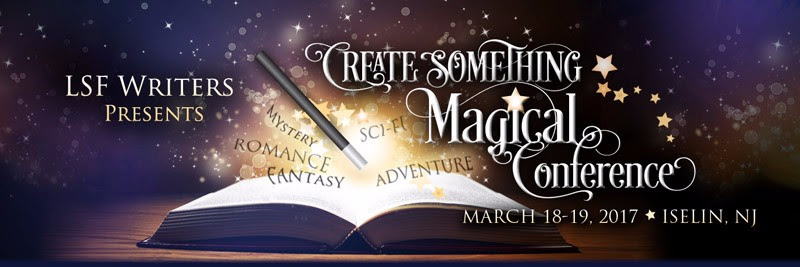
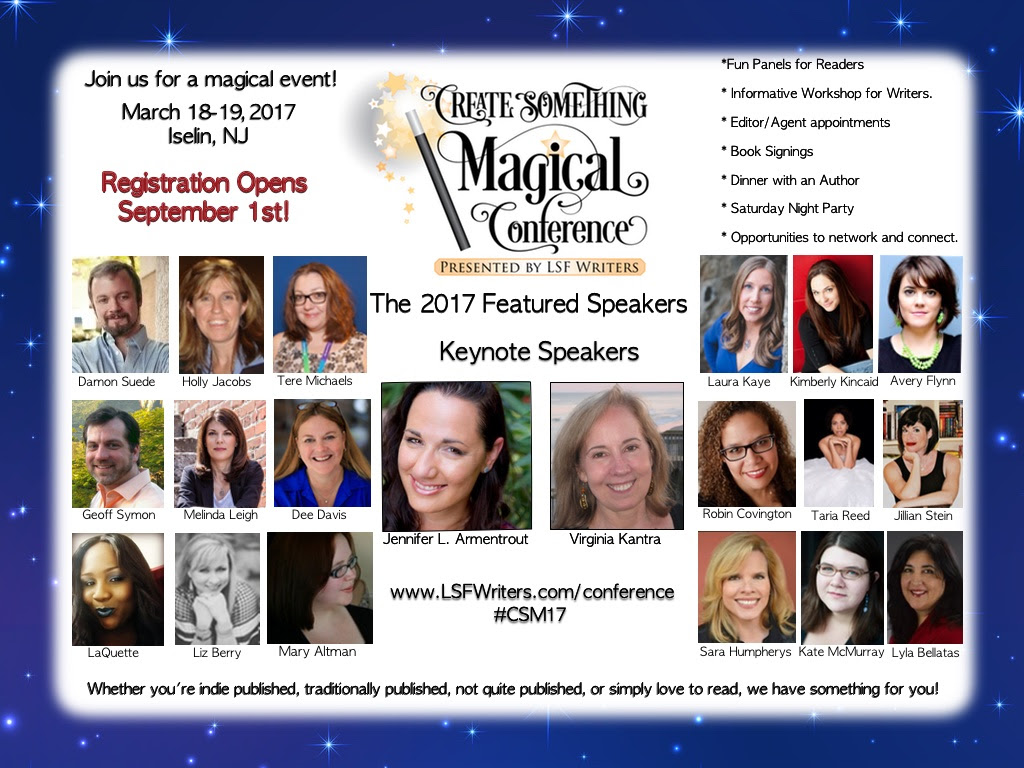
Liberty States Fiction Writers 2017 Create Something Magical Con Registration Opens Sept. 1

untitled

Want to Write? Love to Read?

Mark your calendars for

the 8th annual Create Something Magical Conference.

Whether you’re indie published, traditionally published, not quite published, or simply love to read, in all and all genres of fiction writing, we have something for you. Join us on March 18-19, at the Renaissance Woodbridge Hotel in Iselin, NJ

2017 for a magical event!

LSFW Banner

See Liberty State Fiction Writers for more info!

Methods for your madness

990488Most writing follows a certain form, whether fiction or nonfiction. Newswriting and creative non-fiction are fact-based, humor amuses, biography chronicles a life. Fiction tells an invented story, whereas, genre fiction adheres to certain inherent strictures, ie, mysteries leave clues, romance relates a developing relationship, horror shocks, fantasy world-builds. Readers expect when they pick up a thriller or an autobiography or a true crime that it’ll follow whatever form’s intrinsic to that genre, but what if you want to define what you’re writing even further? This is what I call writing for context, or putting that extra level of specification into your writing–for clarity, for authenticity, to strike the right mood. Shall I explain?

Historical fiction is one of the best examples. Aside from not including an HD TV in your Victorian drawing room, certain phrasing and references will lend you writing more credibility, as well as anchor your reader in the era. The best way to get this is to read works not so much about the time of which you are writing, but from the time. For example, from the 18th century, Jonathan Swift or Henry Fielding, 19th century, Charles Dickens or Mark Twain, early 20th, Sinclair Lewis or F. Scott Fitzgerald.  Pay attention to the cadence of their dialogue, their use of phrasing, their historical references, the position of their wording. He was a hale fellow, or Shall we meet at half-past seven? will lend a certain credence to your writing. Now, no one will expect you to construct your exposition with thees and thous, but if you’re writing about 18th century Quakers, you might expect to see a few of those whiskered words in their dialogue.

Another example is writing in the first person. I find this type of writing gives you the most license to experiment. Take the novel The Curious Incident of the Dog in the Night-Time by Mark Haddon. In this novel he writes from a the perspective of a 15-year-old with Asperger Syndrome. He includes the protagonist’s tics and phobias, sprinkling the narrative with logic and math, numbering his chapters with only prime numbers. By writing with this context in mind, Haddon places us firmly in the character’s mind, and makes the experience resonate long after we put the book down.

There are many examples I could go into to illustrate this principle, but basically, it’s almost like Method Acting, or maybe even a little bit like time travel. As soon as you sit down to write, put yourself into the mind of your character, in both time and setting, and let it lead you down its little garden path. If it’s engrossing enough, your minions will soon follow.


Writers! Seek out your own!

IMG_0114In past posts we’ve explored from preparing for a writing project, confronting the blank page, priming your plot pump, getting past your slumping middle, to wrapping it all up and sending it out the door. But what if you’ve got the will and the way, but you still can’t get your motor started? And what if you’ve got it started, but can’t figure out how to shut it down? Or what if you’re stuck in that sagging middle, and it’s got you so daunted you want to hurl the whole kit-and-kaboodle against the wall? Then maybe it’s time to give both the laptop and the sheet rock a break, because you know what they say: when all else fails–retreat!

No, my dear writers, I’m most certainly not saying you should quit. Five noogies to the head for even considering it! What I’m saying is perhaps you need a change of venue, to step out of your everyday and try a different milieu. Where would you go? Why don’t you try these…

1. Writers Colonies – If you’ve got the wallet for it, writers colonies or residencies are about as close as you can get to literary nirvana. Usually in a picturesque location or town, at a college or camp or hotel, they give you uninterrupted time to write, plot or just stare off into space. Many come with social activities so you can network with fellow writers, some even come with stipends, others you have to qualify for. Check the wonderful website Agent Query for their list of colonies and residencies.

2. Writers Conferences – Every writer should attend at least one a year. I certainly do, have for years, and if you just happen to be in New Jersey in next March , you might want to take a look at Liberty States Fiction Writers’ “Create Something Magical” Conference. It’s for one day, but take the weekend and bookend the schmooze, panels and workshops with some serious writing time. Writers Conferences can range from an afternoon to a week-long series of events, many of them grouped by genre, such as the Romance Writers of America in the summer, or the Backspace Writers Conference in New York this November. Full of workshops, editor/agent appointments, panels, readings, book fairs and the chance to meet some of your favorite authors, if you don’t come out energized and ready to attack the page, then perhaps you’re in the wrong business. Again, here’s another look at Agent Query, and their rundown of upcoming conferences.

3. Book Expo America BEA is one of the premier industry events if you are any way connected. If you’re a bookseller, agent, editor, librarian, educator, book club member, writers’ organization officer or published author you can’t afford to miss it. Held over three days in May, last year in Chicago, but next year back at the Javits Center in New York City, anyone who is anyone in the industry is there. After one hour trolling this convergence of Every Publisher in the Free World, if you don’t feel like closing down that WIP to get in the game, then stay home on the porch. You ain’t gonna be runnin’ with the big dogs.

4. College Literary Festivals – Held by the English Department at a college or university, these usually weeklong events hold readings and signings for writers and readers alike. If you’re alumni, this is a good way to connect with your old professors who no doubt have a line on the writers attending, so you never know who you can meet. I go back to my alma mater twice a year for their festival held during their MFA residencies, meeting many of the visiting writers. I even had dinner with Francine Prose one night, though being one of twelve at her banquet-seating table, I doubt if our conversation went past pass the salt.

5. Create your own – Batton down the home hatches and take off for the weekend, to a vacationing friend or family member’s house, to a off-season cottage by the lake or ocean, to a campsite up in the mountains, or even a bargain-basement afternoon with the laptop or legal pad at the library or Barnes and Noble cafe. Perhaps even send the kids off with the spouse to the zoo and stretch out on the back porch, a glass of your favorite libation at your side, letting all those ideas in your head bounce off the trees, the alleyway, the horizon. It doesn’t take much, just a firm commitment and the time to percolate, and perchance, of course, to dream.