I must have asked myself that question a million times, and I keep asking it without getting any real answers. How many unanswered texts will I tolerate? When is one email too many? Should I call or shouldn’t I? Is ‘no news’ really ‘good news?’ How long is too long? When do I stop soliciting advice and just fly on my intuition? Is it true I simply have to be patient? If that’s true then how long should I wait? Because when is enough actually enough?
To be a writer is to question your resolve over and over again. It goes along with questioning your ability, your stamina, your judgment, your self-esteem. You’re told you really can’t call yourself a writer until you start racking up the rejections, fill your inbox with humiliation, papering your wall with talent assessments from strangers. I once had an award-winning writer dress me down during a manuscript evaluation at a nationally renowned writers conference, literally screaming at me for wasting his time. “Who told you you could write!” he yelled at me, while I stared at him aghast and cowering, too flabbergasted to respond. At least my mind had the good sense to conjure up ASSHOLE! ASSHOLE! over and over again, but that didn’t stop me from fleeing to my room to collapse in teary self-doubt. Little did I know at the time that pre-published incident simply set the stage for more disappointment to come, more rejections, crappy sales, proposals that went nowhere, savage reader reviews. (A word of advice to newly published authors: stay away from Goodreads. The first glowing reader reviews will have you dancing on the ceiling. The first terrible ones will have you wanting to hang from it. Reviews are always subjective. If you want to read any, stick to the movies coming out this week.) Getting published doesn’t wash all the self-doubt away. It just ascends it to a professional level.
You wonder again and again why you do it. Why anyone would put themselves through such a wringer of scrutiny only to fall flat on their face 99% of the time. You wonder as you work through the dark of the night, or amid the first shards of light before waking the kids, as you slip in your flash drive to write at your desk during lunch, or as you tap that perfect passage into your phone on the train ride home. You wonder through the first chapters, through the call to adventure, the sagging middle, the dark moment, finding the elixir. Through that brief moment of absolute serendipity when you type THE END. As you hit SEND to sail your query through to an agent’s website, as you approach an editor at your first pitch session, or tweet only the most essential 140 characters into #MSWL. As you wade through the rejections, as you forget the last to go forward, as the law of averages and the law of even a blind chicken gets a piece of corn now and then, somehow you hear a click and there’s a request for more, then a proposal, then the whole manuscript, then–the unthinkable. Then all the planets line up and the sun finally comes out, and you find out that maybe, just maybe. Maybe you’ll get it right this time.
Then again, maybe you won’t. Maybe all the doom in the world will descend on you, you talentless guttersnipe, your presumptuous amateur, you hopeless fool. After all, who told you you could write?!
Then again, maybe you’re the only one in the world who doesn’t know you can. And then you do it anyway.
Workshop at Liberty States Fiction Writers Conference
And get to a Writers’ Conference for pity’s sake. It doesn’t matter your level of writing proficiency. Like a health care professional–and for your own mental health–you need to get out there and update those skills. So take a look below for the conferences coming up around the country in May, and remember–the best networking is done in the hotel bar!
MAY 2017
ASJA Writers Conference. May 5 – 6, 2017. Concurrent morning & afternoon panels rated from beginning to advances, some for all levels. Luncheon, keynote speaker, networking. 100+ authors, editors, literary agents, publicists.
13th annual PEN World Voices Festival of International Literature. May 1 – May 7, 2017 at various locations in New York City. readings, performances, and panel discussions for poets, fiction writers, and creative nonfiction writers. “The thirteenth annual PEN World Voices Festival will take on some of the vital issues of the Trump-era, with a special focus on today’s restive relationship between gender and power. Taking place in New York City, May 1-7, 2017, the weeklong festival will use the lens of literature and the arts to confront new challenges to free expression and human rights—issues that have been core to PEN America’s mission since its founding. At this historic moment of both unprecedented attacks on core freedoms and the emergence of new forms of resistance, the Festival will offer a platform for a global community of writers, artists and thinkers to connect with concerned citizens and the broader public to fight back against bigotry, hatred and isolationism.”
Northern Colorado Writers Conference. May 5 – 6, 2017, Fort Collins CO. The 2017 Northern Colorado Writers Conference will bring back some local favorites such as Laura Pritchett, Trai Cartwright, and Kerrie Flanagan, as well as welcome several new-to-NCW presenters such as Bob Mayer, Jessica Strawser, and Whitney Davis, and several new agents.
Idaho Writers Guild Conference. May 5 – 6, 2017, Boise, Idaho. Meet with agents, editors, and authors. Panel discussions, workshops, and a keynote speaker. Your registration – $195 for IWG members, $225 for non-members.
Gold Rush Writers Conference. May 5 – 7, 2017, Mokelumne Hill, CA. “Writing professionals will guide you to a publishing bonanza through a series of panels, specialty talks, workshops and celebrity lectures. Go one-on-one with successful poets, novelists, biographers, memoirists and short story writers.” Writing workshops in Autobiography/Memoir, Children’s, Fiction, Marketing, Non-fiction, Poetry, Publishing, Romance, Travel, Young Adult.
The Massachusetts Poetry Festival. May 5 – May 7, 2017, Salem, Massachusetts. The Mass Poetry Festival offers nearly 100 poetry readings and workshops, a small press and literary fair, panels, poetry slams, and open-air readings. More than 150 poets will engage with thousands of New Englanders.
Grub Street Muse and the Marketplace Conference. May 5 – May 7, 2017. Boston, Massachusetts. The Muse and the Marketplace is a three-day literary conference designed to give aspiring writers a better understanding about the craft of writing fiction and non-fiction, to prepare them for the changing world of publishing and promotion, and to create opportunities for meaningful networking. On all three days, prominent and nationally-recognized established and emerging authors lead sessions on the craft of writing—the “muse” side of things—while editors, literary agents, publicists and other industry professionals lead sessions on the business side—the “marketplace.”
Hedgebrook VORTEXT Salon. May 5 – 7, 2017: Whidbey Institute on Whidbey Island, about 35 miles northwest of Seattle. Workshops, panel discussions, lectures, open mics, and time to write in poetry, fiction, and nonfiction for women writers.
Columbus State Community College Writers Conference. May 6, 2017, Columbus, Ohio. Workshops in Autobiography/Memoir, Business/Technical, Fiction, Journalism, Marketing, Non-fiction, Playwriting, Poetry, Publishing, Screenwriting. This one-day conference is free of charge.
DFW Writers Conference. May 6 – 7, 2017, Fort Worth TX. Featuring pitch sessions with literary agents, advanced classes, engaging panels, interactive workshops.
Writers Retreat Workshop. May 6 – 13, 2017, San Antonio, TX. Featuring Author and Instructor Lisa Cron (Wired for Story, Story Genuis), Thriller novelist Daniel Palmer (Delirious, Forgive Me, Mercy (with his late father Michael Palmer) ), Mystery and thriller author Reavis Wortham (Red River Mystery Series, and in 2017 Sonny Hawke series), Author and Instructor Les Edgerton (Bomb, Hooked (WD), The Bitch), Author, Instructor and Editor Carol Dougherty, Author, Instructor, Editor, and Program Director Jason Sitzes, and more agents, editors, and authors. Mokulē‘ia Writers Retreat. May 7 – 12, 2017 in Waialua, Hawaii at Camp Mokulē‘ia, Oahu. Offers workshops in fiction and nonfiction, readings, one-on-one consultations, publishing panels, yoga sessions. The retreat is led by North Shore native Constance Hale, the author of Sin and Syntax, the editor of more than two dozen books, and a journalist whose stories about Hawai‘i appear on CD liner notes, as well as in publications like The Los Angeles Times and Smithsonian magazine. Hale invites a mix of writers, editors, and agents from both the islands and the mainland to lead various workshops and appear on panels.
Novel-In-Progress Bookcamp. May 7- 13, 2017: West Bend WI. 6-day, residential workshop-retreat for writers in all genres working on a novel or creative nonfiction book. Workshops in Autobiography/Memoir, Fiction, Horror, Humor, Mystery, Non-fiction, Publishing, Romance, Science Fiction/Fantasy, Young Adult. Registration is limited to 30 people.
Lakefly Writers Conference. May 12 – 13, 2017: Premier Waterfront Hotel & Convention Center in Oshkosh, Wisconsin. Workshops, talks, and a bookfair for poets, fiction writers, and nonfiction writers. Keynote speaker is Nickolas Butler. Many speakers and presenters.
Seaside Writers Conference. May 14 – 20, 2017: Seaside Assembly Hall in Seaside, Florida. “The Seaside Writers Conference is an annual gathering of creative writers from all over the nation, and features award-winning writers in poetry and fiction and screenwriting who will offer a full week of intensive writing workshops, one day seminars, school outreach programs, and social events.” Many authors, agents, editors.
Writing By Writers Methow Valley Workshop: May 17 – 21, 2017, Winthrop, WA. Faculty: faculty includes Ron Carlson, Ross Gay, Pam Houston and Lidia Yuknavitch. Tuition: $1,650 (before November 1) $1,750 (after November 1) includes one four-day workshop, admittance to all panels and readings, and all meals (dinner on Wednesday; three meals Thursday through Saturday; breakfast and lunch on Sunday) and lodging for four nights. Alumni of the first Methow Valley Workshop in May 2016 will receive a $100 discount.
Pennwriters Conference, May 19 – 21, 2017, Pittsburgh, PA. Friday evening keynote Jonathan Maberry; Saturday afternoon keynote Chuck Sambuchino; and 20+ authors, literary agents & editors, writing industry pros. Costs: $375 for 3-day registration. One-day registration available $185.
Creative Nonfiction Writers’ Conference. May 26 – 27, 2017: Wyndham University Center in Pittsburgh. Master classes, craft discussions, publishing talks, pitch sessions, and readings for creative nonfiction writers. In just three days you can meet one-on-one with a literary agent or publishing consultant, get concrete advice from professional writers, hear what different kinds of editors are looking for, and hone your skills in an inspiring small-group session. You’ll also meet and mingle with writers from across the country who share your excitement about the writing process.
In three weeks I’ll be finished with classes, and then I’ll have about two months off before a summer course I’m teaching starts. In the interim, I’ll be diligently attacking my work-in-progress, becoming the full-time writer I lust to be all year. Now, there’s a couple ways I can approach this. I could stay home and work from my own office, or I can pack up my laptop and head to the library or one of the many local coffee bistros. But leaving home would require assembling myself enough to face that public, and isn’t the whole allure of working from home the fact you can do it in your pajamas? (Though I rarely do it in full make-up, ribboned pigtails, and clingy Union Suit as Miss Bibliophile above. Then again, she must make a habit of not straying very far from that beanbag, as it appears she has an extra apple for nourishment and that bowl it’s sitting in looks suspiciously like what they slide under your bed-ridden self in a nursing home.) Not that working in your pjs doesn’t have its charms.
It’s nice to be able to shuffle from bed to desk, sipping your morning coffee (or tea in my case) while you contemplate your next plot point en déshabillé. There’s a certain freedom in shutting out the outside world so you can fully enter your own, focusing only on the story thus allowing its characters and setting become all the more real. If you approach it with enough preparation, making large-pot food such as soup, chili, and stew, buying enough food you can eat with one hand such as fruit, string cheese, and anything in a bag, and making sure your sig other and family members are well-warned that this book-writing gig is definitely a thing and you mean BUSINESS, then you may be able to pull it off. But you and they, must be fully vested and on board, because you don’t want them giving you the stink eye when you amble into the kitchen at three PM wearing sleep shorts and a t-shirt sans Maidenform, still flushed from that just-finished ass-kicking scene. Or if it’s way past dinner and you suddenly realize that Pop-Tart you just ate was your lunch, and the reason the cat is kneading her claws into your leg is not because she loves you, but because you last fed her twelve hours ago. And that’s only because your bedtime has lately been coming with the sunrise, perfecting the art of sleeping upright and fuck-all to “so-called” circadian rhythms. Truth is, it’s a bitch to admit you’re only the axis to your virtual world, and people can get a bit tetchy if you spend two weeks in your pjs and only leave your office to forage. So what’s the flip side?
Wake up at 6 AM, shower, dress, eat, and be at your desk by seven. Treat it like the job it is, with stretch and coffee breaks, a regular lunch, a walk in the afternoon or early morning to clear your head enough to reflect and reorganize, and with a quitting time reasonable enough to get a good night’s sleep. I’ve done it both ways, as both have their own unique advantages. At times I’ve needed the liberty to work free-form, and at other times I’ve needed the structure to focus. The thing is you have to do what works for you, and if your way isn’t, then perhaps you have to explore an opposite method to know why.
What do you think?
*Don’t get me wrong, in my humble opinion, pajamas work for me. On the other hand…
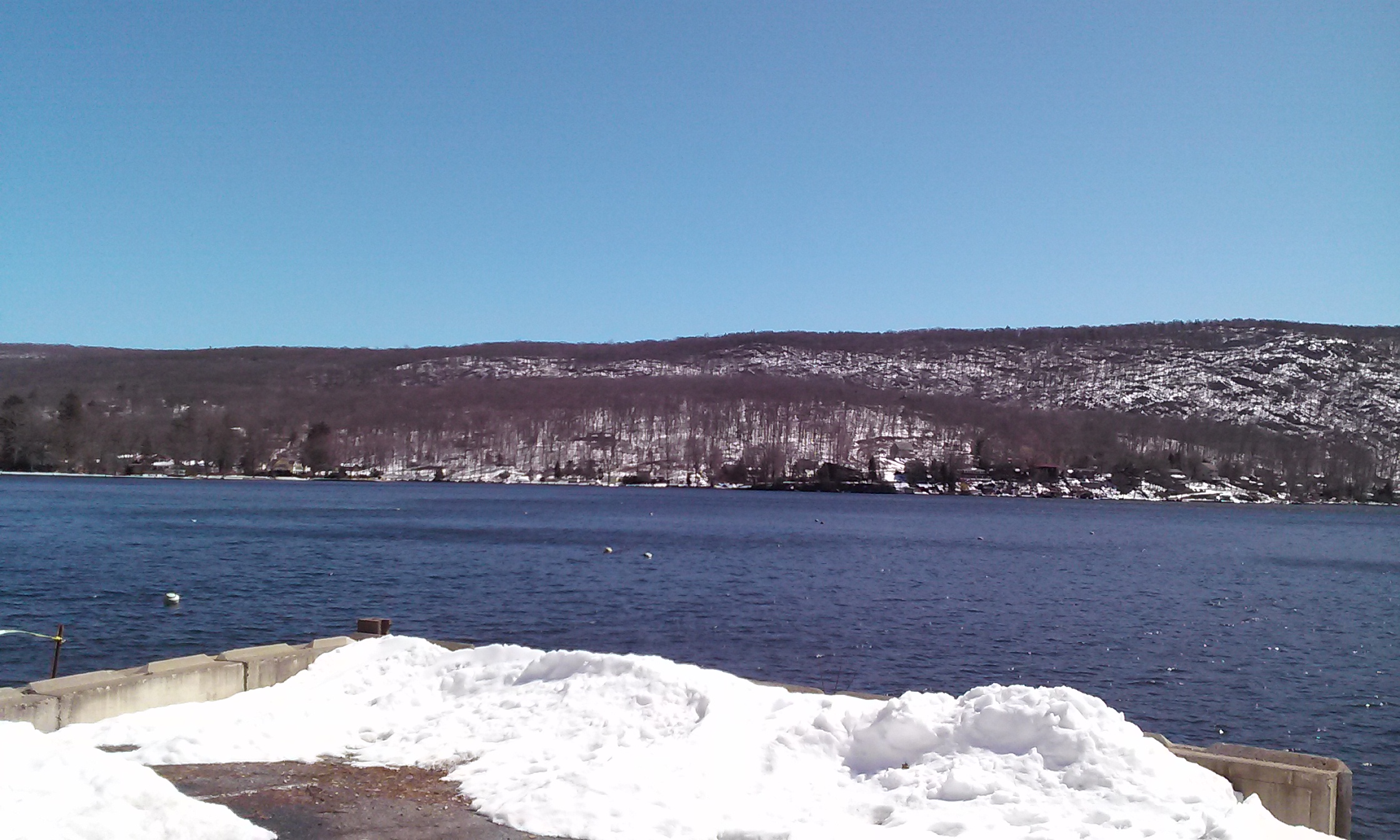
Today I ventured from home and hearth up to Greenwood Lake, NY. It’s a beautiful seven-mile long lake that straddles the border of New York and New Jersey, and the view you see here is what I saw out the window of the restaurant we lunched at. The hills go right down to the lake and are now covered in snow, as is much of the town from the two feet that were dumped on it last week. But I couldn’t help thinking how gorgeous those hills would be decorated in fall colors or in the full thrall of summer. There’s a swimming beach across the lake as well, which I’d dive right into, given the chance. And I’d sure like to catch the sun setting (or rising) over those hills, trailing light and shimmer across the water. And let’s not forget the hot summer nights spent over a beer at that bar, listening to music, trading stories with the locals. Ah, sounds like the life…
So why am I ruminating on this? Because life is thrusting changes upon me, and I’m trying to find that sweet spot that’ll alleviate some of the scratches I’m sure to come away with. Part of that is looking forward to environs and opportunities new and hopefully pleasant, as well as something that’ll guide me towards the inspiration that writers are always looking for. Right now I’m working on a project that may either come to everything or absolutely nothing, and it’ll require a lot of work and research and faith in my abilities. Am I up to it? In my heart of hearts I believe so, but rare the writer that doesn’t occasionally think they’re just faking it, that they’re pretenders, that at any minute they’ll be exposed for the fraud they are. Is that really me? Do I really believe it? Or am I just looking for some adulatory stroking, a reaffirmation of just how fabulous I already know I am?
Does it matter? Because would either reason leave me less deserving? I don’t think so. By nature, writers are a prickly lot, part artist, part introvert, part exhibitionist, intensely clamoring for attention then wary when it’s received. Am I really that good, or are you just being nice?Tell me the truth–do you REALLY like it?
Again, does it matter? Because we both know you’re going to do it anyway. Writing’s a lot like cooking–the process is long and messy, and sometimes–a LOT of times–you get burned. But if you do it right the results can be delicious. Which of course, just make you do it again and again.
Those familiar with this blog know I also teach college, both undergrad and graduate, and this past weekend I finished reading a grad student’s thesis. It’s a young adult urban fantasy, quite inventive, and intrinsically reflective of the everyday life and culture of modern youth (as long as that youth is also a witch, a werewolf, or a supernatural of the author’s own fabrication). The piece was written by a young adult, though not as young as the protagonist, but still young enough to be fully vested in the reality she was presenting. And because of that, I was struck by one thing which has definitely changed since I started writing many years ago–how much our plot devices have been changed by our modern devices.
Think about the plot of the underground classic Rocky Horror Picture Show–a young couple’s car breaks down on a back road in 1975. They have to walk to a house so they can phone for help, thus entering into strange environs where hijinks ensue. But everyone has a phone now, so they’d just call AAA or Roadside Assistance and wait in their car until the tow truck arrives. Or in 1969, when Claire of Dragonfly in Amberneeds to find a copy of the Fraser’s deed of sasine. She must travel to Scotland and ask a county clerk to research it for her. These days, she would simply do a Google search, and locate the county website, communicate through the county portal or email the clerk directly. And how long would a modern Jane Eyre have to wait to find out about the mysterious Mr. Rochester? Seconds via another Google search, or maybe go right to LinkedIn or Facebook or Twitter, or even TMZ or eOnline, hoping whatever trash-talk site of the week has covered he and his latest arm candy, the big player that he is. So how do we work around these new solutions to old plot twists? How do we throw the wrench into the mystery or the romance, tossing a roadblock into the long, complicated trail that leads to our story unraveling?
Damned if I know. But what I do know it’s got to be more than just the phone’s battery dying, the lack of hotspots or WiFi, the profile erased, or any other iteration of deus ex machina. It’s going to take a work-around of creative proportions. Maybe the tow truck arrives is haunted, the deed of sasine has been destroyed in a conflagation, or Mr. Rochester is actually a woman. It doesn’t matter. Just as long as it’s so fresh the pages start turning by themselves.
I really don’t have anything to bitch about. I’m finally deep into this work-in-progress, the characters are getting human and quirky, the plot’s clipping along, and I’m pretty sure the people who have taken an interest in it won’t be disappointed. But here’s the thing: I’m still a slave to my day job, I still have family responsibilities that voraciously command my time, and I’m involved in a couple of professional organizations I wish I had more time for. Then there’s the fact that the deeper I get into this book the more the damn thing follows me around. Like today when I was in the shower and the whole thing decided to coalesce. I mean fuck! I’m in the shower! You know what a royal ass pain it was to hurry out and get to my notepad before it was sucked away by my severely-overworked brain cells? I think I managed to get it all down, but still!
Doesn’t help I’ve put myself on a deadline. No, it’s not from the publisher this time. It’s positively my own. I think I work best that way–assinchair assinchair assinchair. Every single solid free minute not already spoken for is devoted to the act of writing–early mornings before work, complete weekends, after dinner, and late into the night. Sometimes I just sit stare. Other times the words flow like wine. I get up only to stretch my legs and refill my tea mug. Consequently my wrists hurt, my eyes feel strained, my back aches. As I write this I have a shooting pain in my thumb. I have Post-it notes all over my laptop. My bulletin boards can’t fit one more scrap of research and notes. The hard copy of my synopsis is folded over on page four and I still have seven more pages to go. My phone needs charging. My stapler’s empty. Tea’s cold. I have a stack of bills yet to pay. My TBR pile’s getting out of control. I need chocolate. Fritos. Mint chocolate chip gelato. I’ll end up having yogurt eaten over the sink. I have an invitation to a new bar opening in town on Saturday and I still want to go. Roman Holiday‘s on TCM tonight and I still want to watch it. I’ll probably do neither. Still, still, still.
Still, I write. Sometimes so badly my Composition students would probably split their sides laughing. Sometimes so wonderfully I astound myself, thinking I’ve subconsciously plagiarized. Either way I’ll write.
As a follow-up to my sage advice on formatting you manuscript, I asked three agents about how much it matters in their determination on whether to ask to see more or simply hit the delete key. I might add that although there’s varying opinions on its importance, ambivalence aside you always want to make the best impression, so why play fast and loose? Make it the best it can be. But then again this is only my advice and the more you get rejected, the more publishing space that leaves for me. Just sayin’. Anyway, what they said, verbatim…
Marisa Corvisiero of The Corvisiero Literary Agency:
“We don’t put that much importance on the formatting in our decision making. Of course a clean well formatted easy to read manuscript is needed, but unless it makes it difficult to read or is clearly an issue with the authors aptitude, a ms. will not be declined because it isn’t well formatted. However, an agent might not continue reading if difficult to read. They may not even be aware that they don’t want to keep reading because figuring out the format is tiring them out. We prefer Times New Roman font size 12. 1 inch margins. Clear chapter headers.”
Lois Winston of the Ashley Grayson Literary Agency:
“Professionalism is very important. If a writer doesn’t take the time to present a professional query and manuscript, it says to the agent and/or editor that this is a person who will be a headache and take up far too much of the agent’s or editor’s time. There are too many good authors out there who are looking to get published and very few publishing slots in comparison.
“Agents and editors routinely and immediately weed out the unprofessional ones without giving more than a cursory look (if that) to the work. There just aren’t enough hours in the day for any agent or editor to devote to a writer who won’t bother to learn how to present a professional looking submission. There are plenty of books and articles on the Internet that tell writers how to do this. Nowadays, most agents and editors won’t even bother to send a form rejection letter. They immediately hit the delete key.
“MS Word is the standard. I don’t know of any houses that use a different word processing software at this point. The ms. should be formatted in 12-pt. serif font. Times New Roman is the standard, but others are acceptable. (I once had a writer submit a sci-fi ms. in 8-pt. “Star Trek” font. He probably thought he was being ingenious; he was ignorant and stupid. I couldn’t read beyond the first few sentences without getting a headache.)
“Mss. should always be double-spaced. Margins are 1” – 1-1/2”. Typos happen, and we all understand that. I doubt there’s a book that has ever been published that didn’t contain at least one typo, even after multiple proofing from various professional copy editors and proofreaders. However, a manuscript that is loaded with typos from the first page onward will be an instant rejection. Spell-check is a writer’s best friend—as long as you don’t use auto-correct.”
Margaret Bail of Fuse Literary:
“I don’t think there’s any “standard” requirements, but the expectation is definitely for a clean, professional-looking manuscript. It speaks a lot to the author’s seriousness about their career and profession. The decision of an agent and editor should be based on the story itself, not on the formatting (unless formatting is integral to the storytelling in some way), so fancy formatting really just gets in the way of reading the story. Besides, as an agent I’m going to have to clean up and “fix” any fancy stuff before I send it to an editor. And a side note–clean also means a well-edited manuscript. I don’t want to have to spend hours fixing an author’s grammar, spelling, punctuation, etc. If I get that in my inbox I’m not going to request the ms, much less read it.”
So that’s it. Ignore this advice at your peril, or if not, well, you’ve been warned.
Remember when you were in college (or even high school for that matter) and you took a class called Composition? We all had to follow some kind of standard formatting for our essays, whether it be standards set by the MLA (Modern Language Association) or APA (American Psychological Association). It’s no different in the world of publishing. There’s a “somewhat” standardized type of formatting writers follow when submitting work to be published. I say somewhat because all manuscripts, at least in their final form, are subject to a house style which is tailored to a publishing house’s individual preferences. But you can’t know that unless you’ve been sold, so to up those chances, you’ll want to make your manuscript as clean and professionally-presented as possible. You may not think formatting has a place in this, as your story, your ideas, your own unique voice will supersede anything as inconsequential as paragraphing or indents or the proper use of voice tags. But first you have to get that editor or agent to read your work. And if you’re making it too difficult for them to decipher what you’re trying to say, you may never get them to read past the first few lines.
So make it easy for them, beginning with a few basics that are a part of ANY manuscript submission—fiction, nonfiction, poetry, or otherwise.
Make sure your manuscript is the best it can be. Close all plot holes, make sure it has a catchy beginning and a satisfying ending, that your characters are compelling and human. That’s for another workshop, but you do want to make sure you’re happy with your manuscript before you send it off.
PROOFREAD! Correct ALL spelling, punctuation, and grammar. This goes without saying.
Be familiar with where you’re submitting. Check the publisher’s/magazine’s/journal’s submission guidelines for style and formatting. If you’re sending to a particular editor, check to see if they have an individual preference. I worked with a publisher once who did NOT like semicolons. I had to eliminate all from my manuscript. Most times you won’t know this in advance, but if the info’s out there, it’s up to you to find it. Plus it gives you an advantage, the more your know.
Check to see if the publisher/magazine/journal is accepting electronic or paper submissions. They may have different formatting guidelines for each. Most now use electronic submission, but there are still several out there that only take paper, and there are differences.
Okay, so you have your manuscript all spiffed up, and you’re now going to prepare it for submission. What would a properly formatted manuscript look like? I want to caution you that agents and editors as well as publishers, etc. may have different formatting guidelines, but most of what I am showing you is the general consensus of what an ms. should look like, and this is what has worked for me when I submitted.
The publishing industry standard is MS Word, 12 point font (usually Times New Roman). The entire body of the manuscript should be double-spaced.
TITLE PAGE
TOP LEFT – Your name and all contact info, including address, phone number and email in single space.
CENTER, MIDDLE OF PAGE – Title of work in bold and all caps
CENTER, SKIP A LINE – Genre of work with approx. word count
CENTER, SKIP A LINE – the word “by” (in small letters)
CENTER, SKIP A LINE – Your Name
BOTTOM RIGHT – the word “Contact:” followed by agent’s name and all contact info in single space (skip if no agent)
FIRST PAGE OF MANUSCRIPT
TOP LEFT IN HEADER COMMAND – LAST NAME/Title of Work (written like that.) If the title is long, just use the first few words. You need to insert Header in “Header” so this info appears on each page.
TOP RIGHT – Start page numbering, starting with pg. 2, using “Insert Page Number” command so pages automatically advance. Leave the title page blank by using the command in Word.
CENTER, SKIP FOUR OR FIVE LINES – TITLE OF WORK – in bold and in all caps,
CENTER, SKIP A LINE – the word “by” (in small letters)
CENTER, SKIP A LINE – Your Name
CENTER, SKIP A LINE – Again, Genre and word count
CENTER, SKIP A LINE – Chapter One
CENTER, SKIP A LINE – Title of Chapter (in italics, if you’re using one) The chapter number and title of chapter are open to style.
BODY OF MANUSCRIPT FORMATTING
Indent each new paragraph. For ease of use, I use on tab
Indent one tab for each new speaker or when speaker changes
Italics for internal dialogue
Capitalize the first letter of each word for Names
Capitalize the first letter of towns, cites, states, countries, streets, etc., proper nouns and copyrighted names and terms
Capitalize the letter I when you’re using first person (you’d be amazed how many times I see it isn’t)
Encase dialogue “In quotes”
Follow this formatting for voice tags: “I’m not going,” she said. “You’re not going?” he asked. (Comma after last word, followed by the end quotation mark, followed by the voice tag (she said, he asked) followed by a period, or additional info. The voice tag is part of the sentence. Do NOT add an extra space after the quotation mark, or Word will automatically capitalize the following word.
Use * * * * * for scene changes within chapters, or # for change of POV or impact within chapters.
End a chapter by INSERT PAGE BREAK command so the next chapter will start on a new page,
So that’s what’s worked for me. A clean manuscript will keep them reading, but a sloppy one is just one keystroke away from the delete button. Keep them as far away from it as possible.
Yessiree — that’s me. A big ol’ smoking NaNoWriMo fail. I mean I tried–I really did. But I’m just not a verbal vomit type of writer. I’m deliberate. I ponder on a point. I edit, And re-edit. And edit again. That’s what I seem to do best–editing. Can’t stop myself. I just keep going back and forth until I get it right. And I eventually do. I have been published, so there is documented proof. But I just can’t keep writing until my fingers bleed and there’s pus crusting up my eyelashes. And apparently I’m not the only one. I found this on the Oxford Dictionaries blog about other ways to fuck up, so I know I’m not alone. I feel so much better now.
1) Discover a television show you really have to binge watch
‘TV is a great way to learn about crafting dialogue,’ you say to yourself, planning to make detailed notes while watching a modern classic like The Wire or The West Wing. Eighteen hours later, you’re watching the finale of America’s Next Top Model with gummy sweets stuck to your face and empty bottles of wine littering the floor. Yes, great writing can happen on TV – but maybe ration the scenes you want to observe.
2) Get too calculator-happy
To reach that target of 50,000 words in November, you have to write 1,666 words per day. Oh, and another 2/3 of a word on top of that. My first step was working that out, then calculating how many words I could write per hour, how many words I would want to erase per hour, how many words were in the average paragraph, how many words were in the average sentence, and whether I had enough milk for all the cups of tea I’d need. I was exhausted before a word was written.
3) Use literally everything as a reason to cancel
‘I’m a busy, cool, important person,’ I mused, sitting alone in my room and wondering if ‘new BuzzFeed quiz’ was an event worth noting in my diary. My life was definitely too hectic to fit in anything like writing. Yes, sure, cancel if you’re going to your BFF’s birthday party or undergoing emergency surgery, but reasons for cancelling probably shouldn’t include online quizzes, trying out a new recipe, or staring blankly at a wall.
4) Get too obsessed with greatness
I recall the day (aged about 24) when I realized that it was unlikely I’d ever be a child prodigy. I’ve come to terms with that crushing blow, more or less, but I’m still apt to wander along my bookshelves past Austen, Dickens, and Woolf, and get despondent about the fact that my name won’t go down in the annals of history as one of the All Time Greats. That’s ok: there are plenty of other authors out there too.
5) Get overly absorbed, engrossed, occupied, and buried in a thesaurus
Nobody likes the same word several times in a paragraph – well, unless you’re Britney Spears singing ‘Womanizer’, of course – but you can save the finer points of synonym-hunting for later in the process. I got so bogged down in finding a synonym for ‘once’ that I never got as far as ‘upon a time’.
6) Do all the research
While some research is a good thing, too much research is dangerous. While some have the mind for this sort of prodigious content digestion and distillation, most of us don’t. So whether you are deep in a Wikipedia spiral reading about mathematical paradoxes (and plotting the metaphorical significance thereof) or lost in the dusty stacks of your local library cracking open dusty tomes (there might be a reason that book hasn’t been opened in decades), be careful not to get too lost, or you’ll never get anything down on the page at all.
7) Get down with doubt.
Doubt sure feels like your friend at times! The friend who lazes next to your keyboard and tells you to cut that word … oh, and that one also … and maybe that entire character? Really, that whole page/scene/chapter is garbage – far better to just start all over again. Maybe a novel isn’t the best venue for this idea? Maybe a play, or a movie script, or a poem, or a — Eh, you get the picture. (Picture! What about a photo essay?!)
8) Not hitting CTRL + S every five minutes.
Nothing kills the mood like a spectacularly written – and spectacularly unsaved – paragraph. If you’re clever enough to be using a cloud-based document editor, then, well, good for you. I wasn’t.
The opinions and other information contained in OxfordWords blog posts and comments do not necessarily reflect the opinions or positions of Oxford University Press.
 I must have asked myself that question a million times, and I keep asking it without getting any real answers. How many unanswered texts will I tolerate? When is one email too many? Should I call or shouldn’t I? Is ‘no news’ really ‘good news?’ How long is too long? When do I stop soliciting advice and just fly on my intuition? Is it true I simply have to be patient? If that’s true then how long should I wait? Because when is enough actually enough?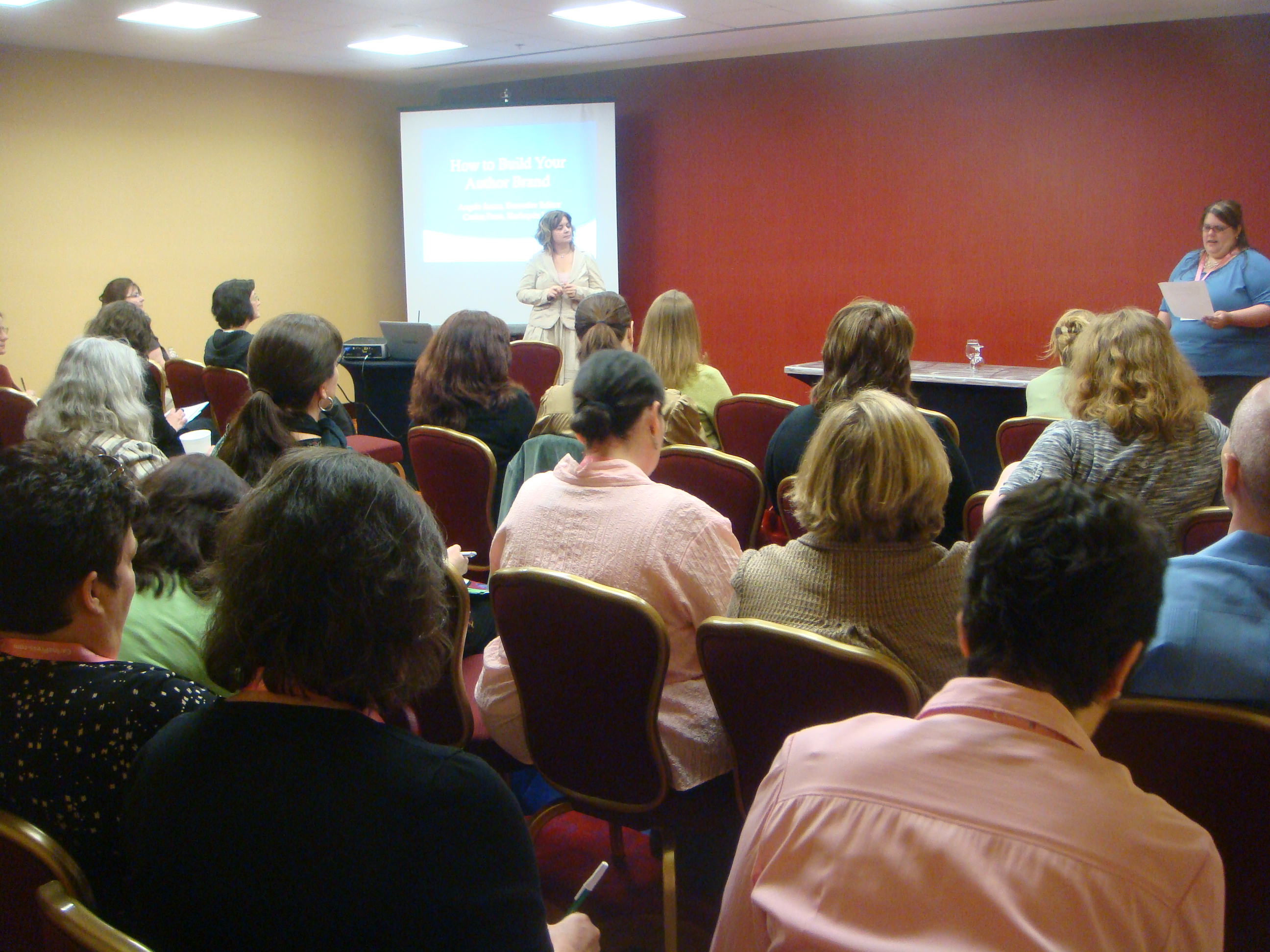




 Gwen Jones Writes