Tag Archives: Writers

The book (lurking) under the bed

If you’re like me, you probably have a book under the bed that hasn’t seen the light of day for quite a long time, and there’s a damn good reason why it’s there. Of course I’m speaking metaphorically when I say under the bed, as most digitally-attuned don’t do paper anymore, and haven’t for a long while. But there was a time when all submissions were typed, tucked in a box, and sent off to New York either Postal Book Rate (cheap and snail-ly) or FedEx (for we oh-so-serious writers), only to have it returned immediately, or a year later after idling awhile in the publisher’s slush pile, a crookedly-photocopied form rejection tucked in the box. To make your repudiation hit home even more, your opus was returned in your own postage-paid box. I say this quite fervently, there’s nothing that’ll give you all the  worse feels than having financed your own dismissal. So after being denied, rebuffed, nixed, and bounced, what can you do with this creative disaster, this repudiated pariah, this literary Loch Nessie,  other than hide it with the other monsters under the bed?

You can have good cry or a  primal scream, and after a good drown in wine or chocolate or Cheetos, figure out why it was under-the-bed-worthy in the first place. Or you can let it molder under your bed or in your hard drive your flash drive or your cloud, and dig it out some time later, and rework and update it until it’s resubmittable again. Though if you do, let me add a few words of caution.

Sometimes editors or agents will give you what’s called a “good rejection,” offering what they found not to work and what would, and maybe even adding they’d take another look after another going over. Sometimes this can work, especially if the ed/agent likes your writing style but wants to see how you rework it first. Often they’ll give your tips, but often they won’t, and there’s no guarantee they’ll take it in the end. It’s the chance you take, because you can get caught up in an endless cycle of revision, especially if the ed/agent wants you to take the book where you may not be adept at. There are writers I know of who were even willing to write outside their comfort zone just to pander to an editor’s taste, ending up in a genre they have no business writing. As hard as it is to accept, some books just belong under the bed, as some just can’t be updated, the original concept may be too trite or convoluted, or your writing style may have changed. Or–and this is a distinct possibility–your skill may have advanced to the point you’ve outgrown the book. Yes! You may be too good for yourself.

So do we go spelunking under the bed and give what lurks there another go? Only you can answer that. Nothing is as comfortable as the familiar. Though nothing is quite as exciting as discovering the newest version of yourself.

The bestest, most glorious Executive Board of any Writers Organization and Conference Ever!

Which is moi, the Veep, Caridad Pinero, our Perfect President, Lois Winston, Secretary, and Linda Parisi, Treasurer, all of Liberty State Fiction Writers. HOO-WAH!

Meet Writers! Editors and Agents in the Flesh! And there’s a bar, too!

Tips from the MFA pit – Part One

Readers of this blog may have noted I teach in an MFA in Creative writing program. From day one students work on what will eventually become their thesis, as well as study the history of their chosen genre, their work process, and a few other writing subjects. Along the way, I dispense advice on all of the above, and dang it! if now and then I’m just chock full ‘o wisdom. I’d like to share a few of those pearls, and what follows is ACTUAL ADVICE FROM A REAL-LIVE MFA MENTOR! To a real-live student (who shall remain nameless lest anyone find out she’s actually listening to me…) Today’s entry is on craft, starting with a lesson on those pesky Voice Tags, and ending with what’s commonly referred to as “Info Dumps…”

VOICE TAGS
You say you hate using voice tags. Well, I don’t know of anyone who loves using them! The thing is it’s not the voice tag itself, as much as indicating in some way who’s doing the speaking. You can also do this by including an action or a reaction by the speaker. For example:
Lana fell back against the bed. “I can’t believe how tired I am.”
“There’s no place to go, so I may as well go home.” Then she closed the door behind her.
Or in a conversation…
Jane knew better than to argue with her sister. Amy, as the eldest,
always believed she was right. But when Amy said she’d rather stay home, Jane took it as the last straw.
Jane stared at her. “You can’t be serious.”
“You better believe I am.”
“But what about the kids?”
Amy shrugged. “They’ll have more fun without me.”
When you have a back-and-forth dialogue, it’s understood that each character takes a new line. You introduce the first character (Jane), then it’s understood, from a previous line of prose (Jane knew better…) that this would be a two way conversation. You just can’t let it go on too long without indicating the speaker, as the readers lose track and it becomes confusing.
Actually, you can write a whole book without using a voice tag doing the above. But sometimes you just have to use them. Especially in action scenes when you want your writing to be more immediate. Too much description can slow the story down. With action, you use short, clipped sentence to show immediacy, and strong voice tags add to the mood or action.
“Shut up,” he snapped, slapping her.
“Yes I’ll marry you!” she cried.
“I’ve never met anymore like you,” he whispered, his voice hot against her ear.
If you find yourself thinking hard and long about which voice tag to use, then you’re using too many variations of them. Use “said” for a statement, and “asked” for a question. Too many variations become clunky, and they draw attention to themselves. After a while, “said” and “asked” become invisible, and that’s what you want. In essence, only use them it its absolutely necessary for clarity.
CHUNKS OF INFORMATION
As I noted before, you want your reader to ride along for the discovery of your plot, and if you “tell” it instead of “show” it, you’ll have your reader bored by page two. This is absolutely essential: you need to grab your reader on the first page. Even better than that – in the first paragraph. The first line. You can’t expect your reader—or an editor or an agent—to wait until Chapter Six for your story to take off. Because what you’re asking is for them to have all this background information in their head that they need to remember BEFORE they could follow your plot. It’s like asking them to learn how to read all the manuals on how to fly a plane before they could ride in one. Divulge your information on a need-to-know basis. Reveal the information as the characters live it. Don’t rob your readers of the delight of discovering it for themselves.

Six of one and a half dozen of the other

Fabulous fiction writing (you know, like the kind I do), just doesn’t magically appear on the page. It’s built around a frame of six major elements, each one essential to the over all narrative. Want to know what they are? I thought you’s never ask!

The Six Major Elements of Fiction

  1. Character — A figure in a literary work (personality, gender, age, etc). E. M. Forester makes a distinction between flat and round characters. Flat characters are types or caricatures defined by a single idea of quality, whereas round characters have the three-dimensional complexity of real people..
  2. Plot – the major events that move the action in a narrative. It is the sequence of major events in a story, usually in a cause-effect relation.

Conflict –  Plot usually involves one or more conflicts, which are problems that need to be solved. The “movement” towards a solution is what drives the narrative forward, and is what occupies most of the protagonist’s time. The more rewarding plots are often built around mental, emotional and moral conflicts.  Plots involving physical conflict, war, exploration, escapes often contain the most excitement and suspense.  Here are the major types of conflict:

  1. Man’s struggle against nature
  2. Man against man
  3. Man against society
  4. Man against himself (i.e. a portrayal of an inner struggle)

The first three types are said to be external conflicts, while the last one is internal.

  1. Point of View — the vantage point from which a narrative is told. A narrative is typically told from a first-person or third-person point of view. In a narrative told from a first-person perspective, the author tells the story through a character who refers to himself or herself as “I.” Third –person narratives come in two types: omniscient and limited. An author taking an omniscient point of view assumes the vantage point of an all-knowing narrator able not only to recount the action thoroughly and reliably but also to enter the mind of any character in the work or any time in order to reveal his or her thoughts, feelings, and beliefs directly to the reader. An author using the limited point of view recounts the story through the eyes of a single character (or occasionally more than one, but not all or the narrator would be an omniscient narrator).
  2. Setting –- That combination of place, historical time, and social milieu that provides the general background for the characters and plot of a literary work. The general setting of a work may differ from the specific setting of an individual scene or event.
  3. Style — The author’s type of diction (choice of words), syntax (arrangement of words), and other linguistic features of a work.
  4. Theme(s) — The central and dominating idea (or ideas) in a literary work. The term also indicates a message or moral implicit in any work of art.

Got it? Now get writing!

Editors and Agents! Live and In Person!

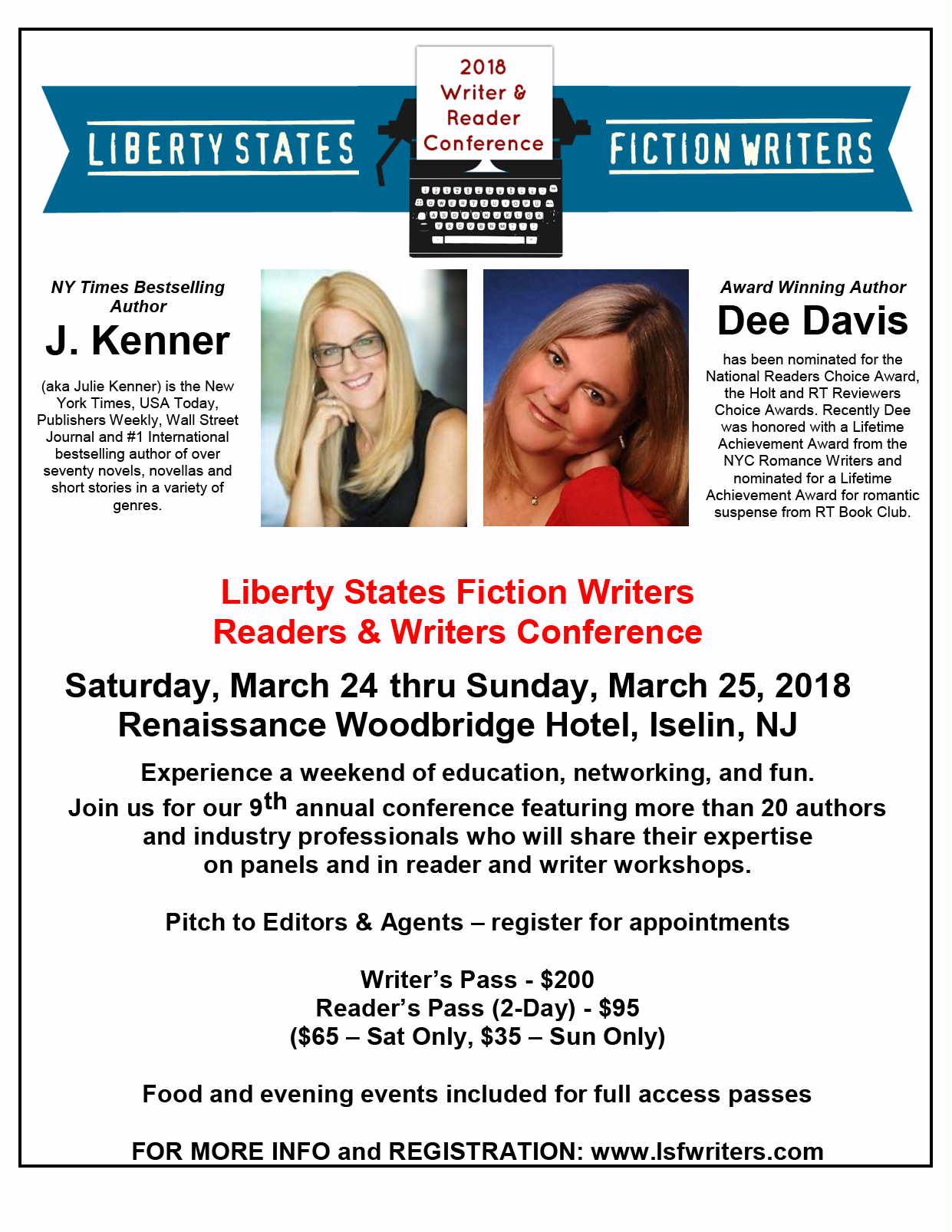
Being a member of Liberty State Fiction Writers affords me the opportunity to go to a great writers conference each year (ours), and to also meet up with editors and agents. Although I’m fortunate to already have a literary agent, there’s always the chance to meet up with editors and other industry professionals, and this affords a lot of opportunities. Like finding out who is buying what, current market trends, new authors and hot titles, and too many perks to mention here. I must say that going to a writers conference that offers chances to sit down with editors or agents, gives you an edge in scoring one if you already don’t have one, or even if you do, and are looking for alternate routes to sell. This year’s LSFW conference on March 24-25 has a great line-up of industry professionals, affording writers a chance to pitch in person. And take it from someone who sold a series of books this way: nothing is better than meeting up in person, so an editor or agent can connect a face to a project. Here’s the line up so far coming to this year’s Liberty States Conference:

Attending Editors

  • Elle Keck – Assistant Editor, Avon Romance
  • Yelena Casale – Executive Editor, City Owl Press
  • Tina Moss – Executive Editor, City Owl Press
  • Jennie Conway – Editorial Assistant, St. Martin’s Press
  • Tiffany Shelton- Swerve/St. Martin
  • Alexandra Hess – Assistant Editor, Skyhorse Publishing

Attending Agents

  • Marisa Corvisiero – Corvisiero Literary Agency
  • Michelle Grajkowski- 3 Seas Literary Agency
  • Lauren Galit – LKG Agency
  • Caitlen Rubino-Bradway – LKG Agency
  • Stephanie Hansen- Metamorphasis Agency
  • Annie Bomke, Annie Bomke Literary Agency
  • Eva Scalzo, Speilburg Literary

Appointments will take place on Saturday, March 24, 2018. You must be registered for the conference writers track to be eligible for an appointment. They are assigned on a first come first serve basis, so be sure to register early. Don’t miss your chance to pitch your book to one of our exciting collection of industry professionals. See Liberty States Fiction Writers Conference page for more info.

Once and awhile I get out in the open

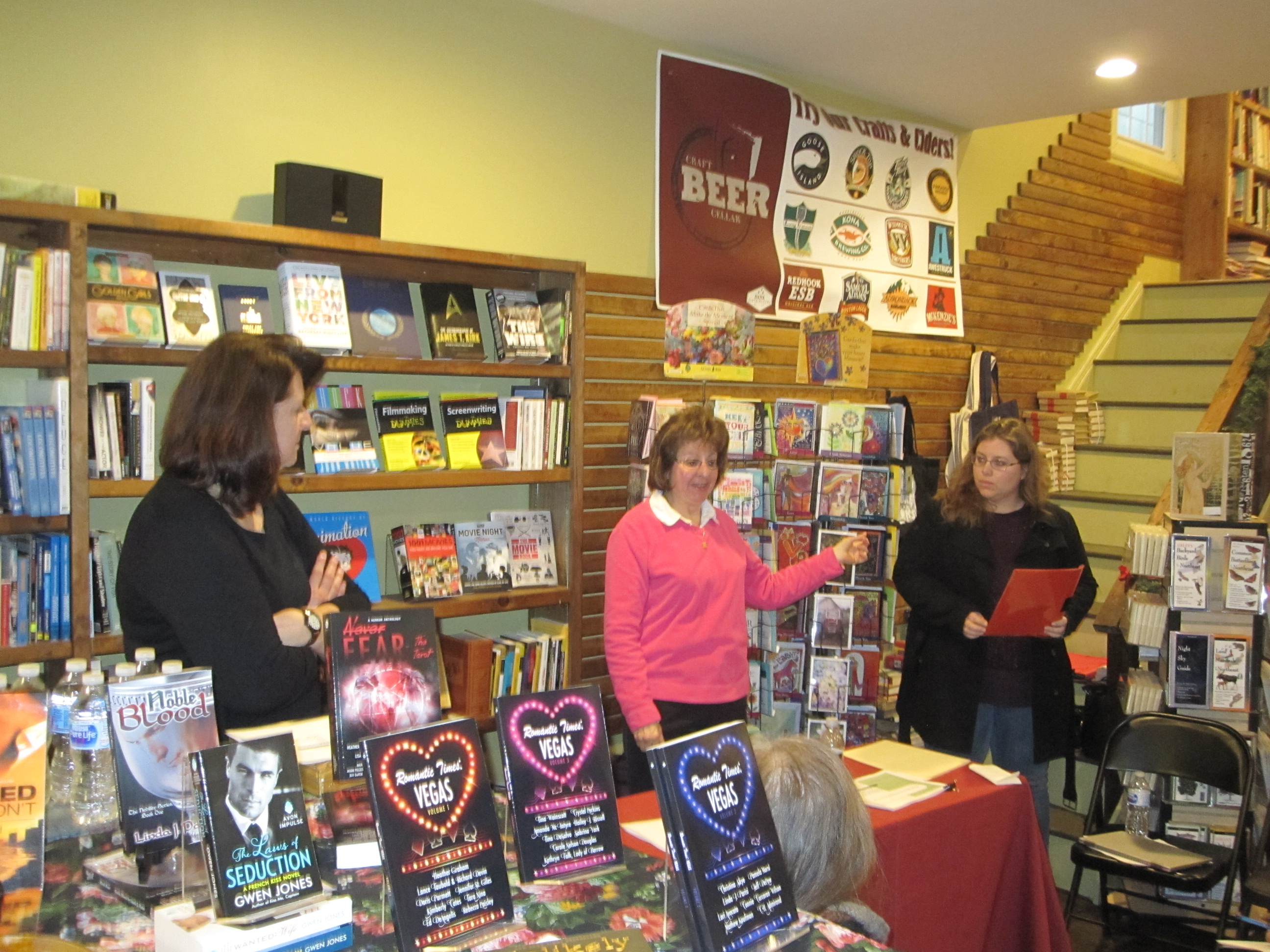
Just a few snaps from the “First Line, First Para, First Page” writers’ workshop Linda J. Parisi and I gave at Ye Olde Warwick Book Shoppe in Greenwood Lake, NY, this past Sunday, January 21.  Great turnout and great press, with a radio spot on WTBQ, Orange County Radio on Thursday,  January 18, and in their local Times Herald-Record, a great local newspaper, a paper that’s the way local newspapers used to and should be still. Anyway, it was fun, the attendees packed the shop, and they want us to come back in the spring. They’re just asking for it, I suppose. Many thanks to store manager Maria Stasolla for hosting us!

The side of Gwen Jones’ head next to Linda J. Parisi, fellow speaker and workshop-giver.
Attendees intently listening and asking questions.
And me, intently listening to Linda and attendee Tiffany.
“What did you say?”
Linda, captivating the crowd.

Appearing Live! In Greenwood Lake, NY

WHO: Gwen Jones and Linda Parisi

WHAT: “First Line, First Para, First Page” Writers’ Workshop.

WHEN: Sunday, 21 January, 2018, from 1:00 – 3:00 PM.

WHERE: Ye Olde Warwick Book Shoppe, Greenwood Lake, NY

WHY: Learn how to create a catchy opening page to capture attention of editors and agents. Bring first page of work-in-progress. Please RSVP, space is limited.

HOW: By showing up. What are you, some kinda smart guy?

Book signing and author mingle to follow. Accolades shamelessly accepted. Click here for more information.

Come on writers, what are you waiting for?

Snowmageddon awaits

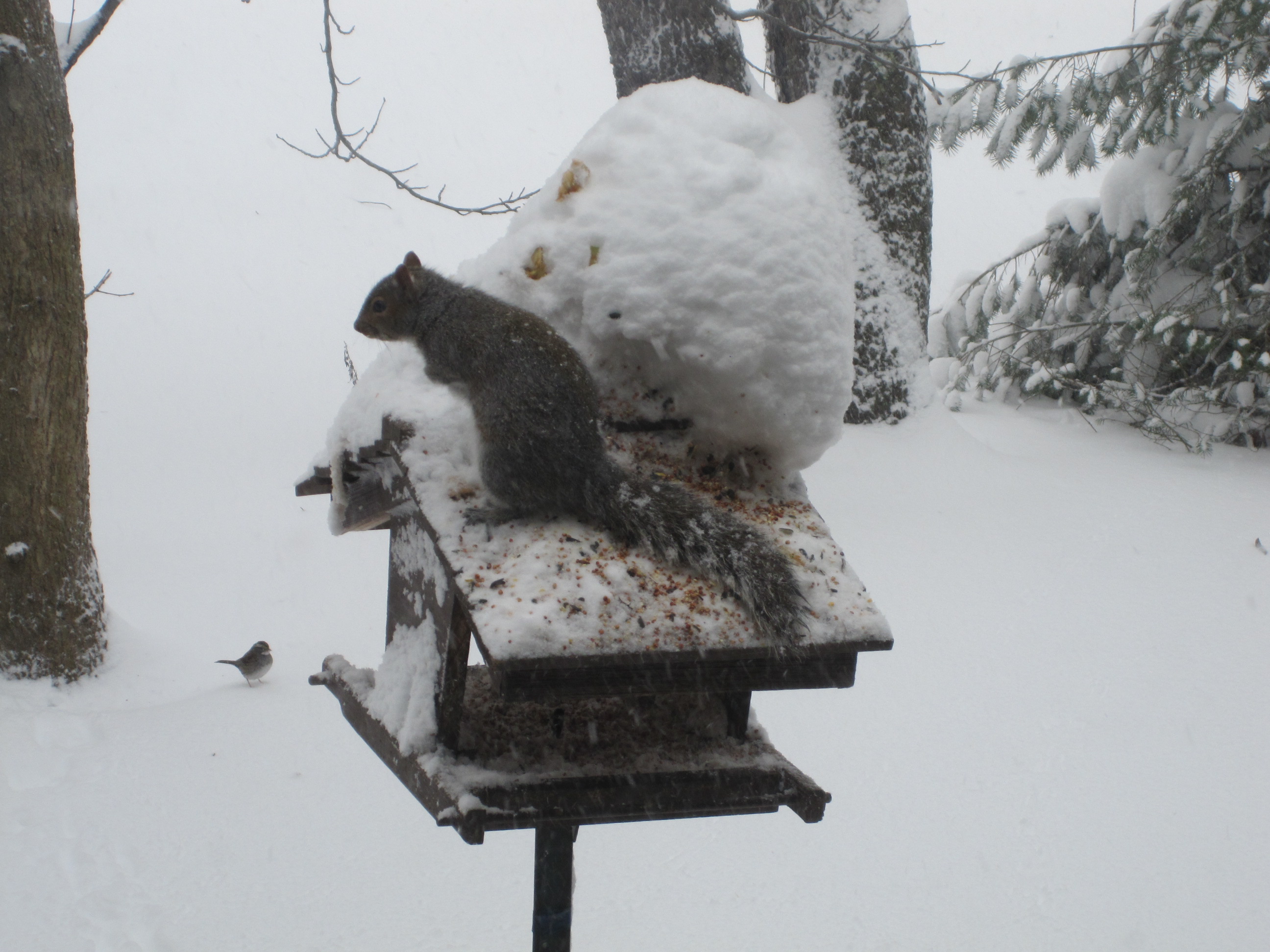
It was sunny and clear this afternoon in New Jersey, and unlike the photo to the left, snow-free. (Though that’s to change soon as a blizzard is barrelling up the coast) The wind was relatively calm, and from my window I could see all kinds of birds pecking at the feeder and except for the barren vegetation, it could have been almost be anytime of the year. But it isn’t, and I don’t need to step outside into the low-twenties chill to feel the hollowness of the season in my bones. After the choreographed optimism of the New Year fades into the mundane, what are we actually left with? Only the anti-climatic yawn of the Dead of Winter and the ennui that follows.

Maybe it’s just a sugar crash after all those Christmas cookies, but last fall’s good intentions and best laid plans now seem as sensible as earmuffs in August, and you’re left staring at a whole lot of letdowns. What happened to that get-up-and-go, those ideas that seemed so workable, those plans set to be implemented as soon as the everything got back to normal, post-holiday? Instead, you’re quickly finding out that things don’t really change, that everything goes comfortably back to the way it was, or more often than not, gets just a little bit worse.  You’re finding yourself just a little more broke, a touch fatter, a tad less cheerful and a whole lot lazier. A stretch on the sofa feels more natural that an extended stretch at laptop, and when you do find yourself in front of a screen, it’s more likely for Netflix than for fixing that severely flawed manuscript.

Not that you haven’t tried. To fix that manuscript, I mean. But everything you seem to write is crap. As it was the last time you looked at it just before Christmas. When you told yourself you’d make it better next month. When you had more time. When everything calmed down.  After the New Year. When all that holiday hoo-hah is behind you and you can finally think again. In January. Because in January the Universe presses the big RESET button and all wrongs get righted, everything gone down goes up, all promises are kept. When the Muse of Inspiration suddenly infuses us with glorious plot threads, miraculous turns-of-phrase and endings so sock-blowing that ever-elusive editor you queried back in the fall suddenly jumps from your proposal and screeches “MY GOD! THIS IS GONNA MAKE US MILLIONS!”

As if. So what to do?

Beats me. I’m depressed, remember? Deads of Winter tend to breed brain-deadness. Or at least that’s how it feels from here. All I can offer is this isn’t my first Dead of Winter, that I’ve made it through several, and there’s just something about January that breeds contempt. And invariably, things do pick up by February. Maybe it is all that holiday crap we ingested and like a six-year-old on Halloween night, we just need to sleep it off.

Here’s hoping. Back to work….